
In the journey of every civil servant, there comes a moment when knowledge meets character, when intellect encounters conscience. This intersection is precisely what the UPSC GS Paper 4 on Ethics, Integrity, and Aptitude seeks to evaluate. Often called the “game-changer” among Mains papers, GS Paper 4 carries immense significance not just in terms of marks but in shaping the very foundation of an ethical administrator.
Unlike the other General Studies papers that primarily test your knowledge and analytical abilities, GS Paper 4 delves deeper—it examines your value system, your moral compass, and your ability to navigate complex ethical dilemmas that you will inevitably face as a civil servant. With 250 marks at stake and a scoring potential that can significantly boost your overall Mains score, this paper deserves your focused attention and strategic preparation.
Many aspirants initially underestimate this paper, thinking that ethics is “common sense” or something that can be prepared in the last few weeks. However, those who excel in this paper understand that it requires consistent effort, introspection, and a structured approach to internalize concepts and develop the ability to articulate nuanced perspectives.
In this comprehensive guide, I will walk you through everything you need to master GS Paper 4—from understanding the syllabus and selecting the right books to adopting a strategic study approach and excelling in answer writing. Let’s embark on this journey together.
Table of Content – UPSC GS Paper 4 Preparation Strategy
- Understanding UPSC GS Paper 4 (Ethics, Integrity & Aptitude) 1.1 What Makes GS Paper 4 Unique 1.2 Syllabus Breakdown 1.3 Paper Pattern and Marking Scheme
- Essential Booklist for GS Paper 4 2.1 Core Reference Books 2.2 Supplementary Resources 2.3 Daily Newspapers and Magazines
- Preparation Strategy for GS Paper 4 3.1 Building Conceptual Foundation 3.2 Case Study Analysis and Application 3.3 Answer Writing and Refinement
- Mastering Different Components 4.1 Theory and Concepts 4.2 Case Studies 4.3 Quotes and Thinkers
- Answer Writing Techniques for Ethics Paper 5.1 Structure and Presentation 5.2 Balancing Multiple Perspectives 5.3 Use of Examples and Illustrations
- Current Affairs Integration 6.1 Ethical Issues in News 6.2 Linking Theory with Practice
- DOs and DON’Ts
- Strategic Study Approach
- Conclusion
Understanding UPSC GS Paper 4 (Ethics, Integrity & Aptitude)
What Makes GS Paper 4 Unique
GS Paper 4 stands apart from other papers in several fundamental ways. First, it is not purely knowledge-based—you cannot simply memorize facts and reproduce them in the exam. Instead, this paper tests your ability to apply ethical principles to real-world situations, demonstrate moral reasoning, and articulate balanced perspectives on complex dilemmas.
Second, the paper has a significant subjective component. While there are some theoretical questions that have definite answers, many questions, especially case studies, require you to present your own reasoning and justification. The examiner is not looking for a “right” answer but rather a well-reasoned, ethically sound, and practically feasible approach.
Third, this paper directly connects to what you will do as a civil servant. The ethical dilemmas presented in case studies mirror situations you might encounter in your administrative career—corruption, conflict of interest, pressure from superiors, public welfare versus individual rights, and so on.
Syllabus Breakdown
The UPSC GS Paper 4 syllabus is divided into two main sections:
Section A: Theory and Concepts (approximately 125 marks) This section covers ethics and human interface, attitude, aptitude, emotional intelligence, contributions of moral thinkers from India and the world, public/civil service values, probity in governance, and theoretical aspects of ethics in public administration.
Section B: Case Studies (approximately 125 marks) This section presents real-world scenarios and ethical dilemmas that test your ability to apply ethical principles, analyze stakeholders, identify conflicts, and propose balanced solutions.
The syllabus explicitly mentions topics like ethics in private and public relationships, human values, attitude content and its influence, emotional intelligence, contributions of thinkers like Gandhi, Confucius, Plato, public service values, governance issues, case studies on probity in governance, and ethical concerns in international relations.
Paper Pattern and Marking Scheme
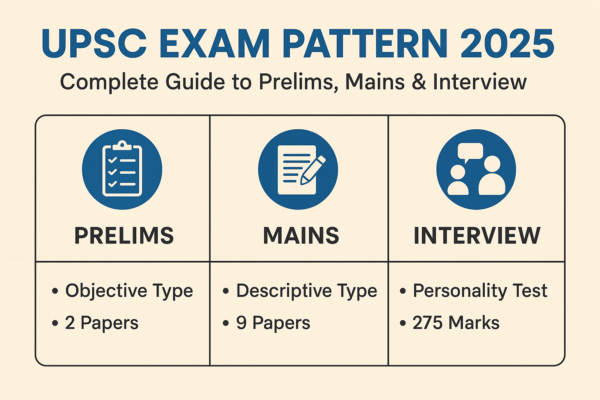
The paper is of 250 marks and 3 hours duration. Typically, Section A contains 10-12 questions of varying marks (from 10 to 20 marks), while Section B contains 5-6 case studies of 20-25 marks each. The questions in Section A can be direct theoretical questions, application-based questions, or questions requiring you to comment on quotes or statements. Case studies usually present complex scenarios with multiple stakeholders and conflicting values.
Essential Booklist for GS Paper 4
Core Reference Books
Selecting the right books is crucial for building a strong conceptual foundation. Here’s a curated booklist that covers the entire syllabus comprehensively:
For Theory and Concepts: Start with standard textbooks on ethics that provide a clear understanding of basic concepts, theories, and thinkers. Look for books that explain ethical theories, such as utilitarianism, deontology, virtue ethics, and their applications in governance. These books should also cover topics like emotional intelligence, aptitude, and attitude in detail.
For Case Studies: Practice is essential for case studies. Look for books that provide a diverse range of case studies with model answers. These resources help you understand how to structure your answers, analyze stakeholders, identify ethical dilemmas, and propose solutions.
For Thinkers and Philosophers: You need a reliable source that covers contributions of Indian and Western moral thinkers. This should include Gandhi, Kautilya, Buddha, Vivekananda, as well as Western philosophers like Aristotle, Kant, and Mill. Understanding their core philosophies and being able to relate them to modern governance is crucial.
Supplementary Resources
Beyond core books, several supplementary resources can enrich your preparation. Government reports on ethics and governance, such as the Second Administrative Reforms Commission reports, provide valuable insights into probity in public life. Biographies and autobiographies of ethical leaders can offer real-life examples and inspiration.
Additionally, online resources and video lectures can help clarify complex concepts. Many aspirants find it useful to maintain a personal diary of ethical dilemmas they encounter in daily life or news, along with their reflections.
Daily Newspapers and Magazines
Current affairs play a vital role in GS Paper 4. Reading newspapers daily helps you identify contemporary ethical issues—corruption cases, whistleblower incidents, environmental conflicts, healthcare ethics, and so on. Pay special attention to editorial pages and opinion pieces that discuss ethical dimensions of current events.
Monthly magazines dedicated to civil services preparation often have dedicated sections on ethics and governance. These provide curated content and analysis that can directly supplement your preparation.
Preparation Strategy for GS Paper 4
Building Conceptual Foundation
The first phase of your preparation should focus on building a solid conceptual base. Start by thoroughly reading the syllabus and understanding what each topic entails. Then, systematically cover all theoretical topics using your core reference books.
Create concise notes for each concept—what it means, why it’s important, and how it applies to civil services. For instance, when studying emotional intelligence, note down its components (self-awareness, self-regulation, motivation, empathy, social skills) and how each contributes to effective administration.
During this phase, also begin compiling a list of thinkers and their key contributions. For each thinker, note their core philosophy, important quotes, and relevance to modern governance. This compilation will serve as a quick revision resource later.
Case Study Analysis and Application
Once you have a reasonable grasp of theoretical concepts, move to case study analysis. Start by reading solved case studies to understand the approach. Notice how answers are structured—problem identification, stakeholder analysis, ethical dilemmas, values in conflict, possible courses of action, and justified recommendations.
Then, begin practicing case studies on your own. Initially, you may find it challenging to identify all stakeholders or ethical dimensions, but with practice, this becomes intuitive. Try to solve at least 3-4 case studies per week, gradually increasing the complexity.
After writing each case study answer, critically evaluate it. Did you identify all stakeholders? Did you consider multiple perspectives? Is your solution practically feasible? Is it ethically sound? Seeking feedback from peers or mentors can be extremely valuable during this phase.
Answer Writing and Refinement
In the final phase, focus on refining your answer writing skills. This involves improving your articulation, presentation, and time management. Practice writing answers within the time limit—typically, you should spend 12-15 minutes on a 150-word answer and 20-25 minutes on a case study.
Pay attention to presentation. Use bullet points, underline key terms, and maintain a clear structure. Your answers should be easy to read and evaluate. Also, consciously incorporate examples, quotes, and current affairs references to substantiate your arguments.
During this phase, take full-length mock tests for GS Paper 4. This helps you understand the exam pattern, manage time effectively, and build exam temperament. Analyze your performance in each mock test to identify weak areas and work on them.
Mastering Different Components
Theory and Concepts
Theoretical questions test your understanding of fundamental concepts. To master this section, ensure that you can define, explain, and illustrate each concept with examples. For instance, if asked about “probity in governance,” you should be able to define it, explain its importance, discuss challenges, and cite examples of both adherence and violation.
Create concept maps or mind maps to visualize relationships between different concepts. For example, how does emotional intelligence relate to ethical leadership? How do personal values influence public service values? Such connections help in answering application-based theoretical questions.
Case Studies
Case studies are where most aspirants struggle initially. The key to mastering case studies is to develop a systematic approach. Start by carefully reading the case, identifying the protagonist (usually you in a particular role), all stakeholders, the ethical dilemma(s), and conflicting values.
Then, analyze possible courses of action. For each option, consider the consequences, ethical justification, and practical feasibility. Finally, recommend the best course of action with clear reasoning. Remember, in many cases, there’s no perfect solution—you’re choosing the “least harmful” or “most beneficial” option among imperfect alternatives.
Practice diverse case studies—those involving corruption, whistleblowing, conflict of interest, resource allocation, public welfare versus individual rights, and so on. This diversity prepares you for any scenario in the actual exam.
Quotes and Thinkers
Questions on quotes and thinkers test your understanding of different philosophical perspectives and your ability to relate them to governance. For such questions, first explain the quote in your own words, then discuss its relevance to civil services, and finally provide contemporary examples.
For instance, if asked about Gandhi’s quote on “means and ends,” explain that Gandhi believed means are as important as ends, discuss how this applies to governance (ethical means in policy implementation), and cite examples where unethical means were used for supposedly good ends, leading to problems.
Answer Writing Techniques for Ethics Paper
Structure and Presentation
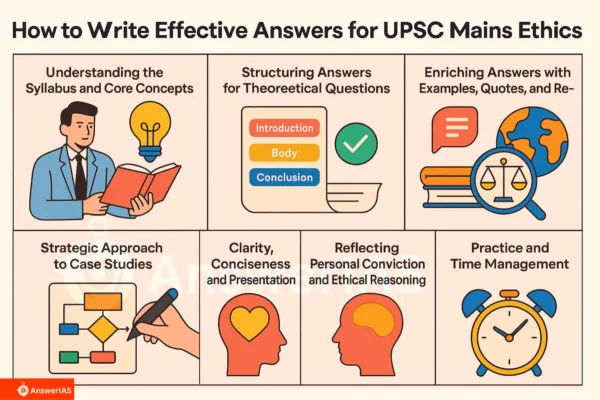
A well-structured answer creates a positive impression on the examiner. For theoretical questions, follow a simple structure: Introduction (define the concept), Body (elaborate with dimensions, significance, challenges), and Conclusion (way forward or your perspective).
For case studies, use this structure: Brief context, Stakeholder analysis, Ethical dilemmas and values in conflict, Possible courses of action with pros and cons, Your recommendation with justification, and Conclusion.
Use headings, subheadings, and bullet points appropriately. Underline key terms and phrases. Ensure your handwriting is legible and presentation is neat. These seemingly small factors significantly impact your score.
Balancing Multiple Perspectives
One mark of a mature answer is the ability to present multiple perspectives before arriving at your conclusion. For instance, in a case involving development versus environment, acknowledge both the need for economic growth and environmental conservation. Present arguments from both sides fairly before recommending a balanced approach.
This demonstrates that you understand the complexity of real-world governance, where decisions often involve trade-offs. It shows you can empathize with different stakeholders and consider diverse viewpoints—a crucial skill for a civil servant.
Use of Examples and Illustrations
Examples breathe life into your answers. They demonstrate that you can connect theory with practice. Use a mix of historical examples, contemporary examples from current affairs, and hypothetical examples to illustrate your points.
For instance, when discussing “integrity in public life,” you could cite historical examples of honest administrators, recent cases of whistleblowers who upheld integrity, or hypothetical scenarios showing how integrity guides decision-making. Relevant quotes from thinkers also serve as powerful illustrations.
Current Affairs Integration
Ethical Issues in News
Make it a habit to identify ethical dimensions in daily news. When you read about a policy decision, ask yourself: What are the ethical implications? Who benefits? Who is disadvantaged? Are there any conflicts of interest? Is the decision procedurally and ethically sound?
Maintain a separate notebook for current affairs relevant to ethics. Categorize issues under different heads—corruption, environmental ethics, bioethics, media ethics, business ethics, and so on. This organized compilation becomes invaluable for answer writing practice and revision.
Linking Theory with Practice
The real power of GS Paper 4 preparation lies in linking theoretical concepts with practical situations. When you study a concept like “public interest,” immediately think of recent examples where public interest was at the center of a policy debate—say, land acquisition laws, vaccination mandates, or privacy concerns in digital governance.
This practice not only enriches your understanding but also ensures that your answers are grounded in reality. Examiners appreciate answers that show awareness of contemporary challenges and the application of ethical principles to address them.
DOs and DON’Ts
DOs:
- Start Early: Don’t leave GS Paper 4 for the last minute. It requires consistent preparation and internalization of concepts.
- Practice Regularly: Solve case studies regularly throughout your preparation. Aim for at least 50-60 well-practiced case studies before the exam.
- Develop Your Own Perspective: Don’t just memorize model answers. Develop your own approach to ethical dilemmas based on your values and reasoning.
- Read Widely: Read beyond your core textbooks. Biographies, newspapers, and philosophical texts enrich your perspective.
- Seek Feedback: Get your answers evaluated by mentors or peers. Constructive feedback is invaluable for improvement.
- Stay Updated: Keep abreast of contemporary ethical issues in governance, technology, environment, and society.
- Revise Concepts: Regular revision of theoretical concepts, thinkers, and quotes is essential for retention.
DON’Ts:
- Don’t Ignore Theory: Some aspirants focus only on case studies, neglecting theoretical preparation. Both sections are equally important.
- Don’t Be Preachy: In your answers, avoid being overly moralistic or preachy. Maintain a balanced, pragmatic tone.
- Don’t Use Jargon Unnecessarily: Use simple, clear language. Don’t complicate your answers with unnecessary jargon.
- Don’t Be One-Dimensional: Avoid presenting only one perspective. Show that you understand the complexity of ethical dilemmas.
- Don’t Copy Model Answers Verbatim: Use model answers as guides, not as templates to memorize and reproduce.
- Don’t Neglect Presentation: Poor handwriting and messy presentation can cost you marks even if your content is good.
- Don’t Procrastinate: Ethics requires consistent, sustained effort. Last-minute preparation rarely yields good results.
Strategic Study Approach
To effectively prepare for GS Paper 4, adopt a flexible, phase-based framework rather than a rigid daily schedule. Here’s a strategic approach:
Foundation Phase (2-3 months): Focus on completing the theoretical portion of the syllabus. Read your core reference books systematically, make concise notes, and compile information on thinkers and philosophers. Simultaneously, begin reading newspapers with an “ethics lens” to identify relevant current affairs. By the end of this phase, you should have a comprehensive understanding of all theoretical concepts.
Application Phase (2-3 months): Shift your focus to case study practice and answer writing. Solve a variety of case studies, starting with simpler ones and gradually moving to complex scenarios. Practice writing theoretical answers as well, incorporating examples and current affairs. Aim to practice at least 3-4 case studies and 5-6 theoretical questions per week. Get your answers evaluated and work on improving based on feedback.
Consolidation Phase (1-2 months): In the final phase, focus on revision, mock tests, and refinement. Revise all theoretical concepts, go through your notes on thinkers, and review your case study practice. Take full-length mock tests to build exam temperament and improve time management. Analyze each mock test thoroughly and work on weak areas. Create a one-page summary of key concepts, important quotes, and your approach to different types of case studies for quick last-minute revision.
Weekly Targets: Instead of a day-by-day plan, set weekly targets. For example:
- Week 1-4: Complete syllabus topics on ethics, values, and attitude; compile notes on 5-6 Indian thinkers.
- Week 5-8: Complete remaining theoretical topics; compile notes on Western thinkers; begin case study practice (2-3 per week).
- Week 9-12: Intensive case study practice (4-5 per week); theoretical answer writing; first mock test.
- Week 13-16: Continue practice; incorporate current affairs; second and third mock tests; identify weak areas.
- Week 17-20: Revision; polish answer writing skills; final mock tests; create quick revision notes.
This flexible framework allows you to adjust based on your progress, other paper preparations, and personal circumstances while ensuring comprehensive coverage.
Conclusion
GS Paper 4 is not just another paper to be cleared; it’s an opportunity to reflect on the values that will guide your career as a civil servant. The ethical principles you internalize during this preparation will serve you well beyond the exam—in every decision you make, every challenge you face, and every life you touch through your administrative actions.
Remember that ethics is not about finding the “right” answer but about developing the ability to reason through complex situations, balance competing interests, and make decisions that uphold both individual dignity and collective welfare. It’s about being true to your conscience while being pragmatic in your approach.
As you prepare for this paper, allow yourself to grow not just as an aspirant but as a thinking, empathetic individual who understands the weight of public office and the responsibility it entails. The time and effort you invest in GS Paper 4 will shape not just your Mains score but the kind of administrator you will become.
I wish you clarity of thought, strength of character, and success in your preparation. Stay committed, stay ethical, and remember that the journey of preparing for GS Paper 4 is as important as the destination.
Keep Learning, Keep Growing!
About the Author
As a senior UPSC mentor with over a decade of experience guiding civil services aspirants, I have had the privilege of witnessing the transformative power of ethical preparation. My journey in the field of civil services education has been driven by a deep commitment to nurturing not just successful candidates but ethical administrators who will serve the nation with integrity and compassion. Through this blog, I aim to share insights, strategies, and guidance that can empower you to excel in your UPSC journey while staying grounded in strong values and principles.
UPSC CSE – Related Resources
- Mock Tests for GS Paper 4: Practice authentic case studies and theoretical questions
- Previous Year Question Papers: Analyze trends and question patterns from 2013-2024
- Comprehensive Booklist: Curated list of recommended books for ethics preparation
- Current Affairs Compilation: Monthly digest of ethical issues in news
- Model Answers: Well-structured sample answers for practice and learning
- Ethics Quotes Database: Compilation of important quotes from Indian and Western thinkers
FAQs: UPSC GS Paper 4 Preparation Strategy
Q1: Can I prepare for GS Paper 4 without formal coaching? Absolutely. GS Paper 4 is one of the most self-study-friendly papers in the UPSC syllabus. With the right books, consistent practice, and regular self-evaluation, you can excel in this paper through self-study. However, getting your answers evaluated by experienced mentors or peers is highly beneficial.
Q2: How many months of preparation are required for GS Paper 4? Ideally, dedicate 4-6 months for comprehensive preparation of GS Paper 4. This allows sufficient time for covering theory, practicing case studies, incorporating current affairs, and revising. However, if you’re starting late, a focused 3-month preparation can also yield good results.
Q3: Is GS Paper 4 a scoring paper? Yes, GS Paper 4 is considered a scoring paper by many toppers. Unlike papers that require extensive factual knowledge, this paper rewards clear thinking, balanced perspectives, and good presentation. With proper preparation, scoring 110-130 marks out of 250 is achievable for most well-prepared aspirants.
Q4: How important are quotes and thinkers in GS Paper 4? Quotes and thinkers are moderately important. While you don’t need to memorize hundreds of quotes, having a good collection of 30-40 relevant quotes and a solid understanding of 10-12 key thinkers (both Indian and Western) is sufficient. The key is to use them judiciously and contextually in your answers.
Q5: Should I write case study answers in first person or third person? In most case studies, you’re given a specific role (e.g., “You are a District Magistrate…”). In such cases, write in the first person—it makes your answer more direct and authentic. However, when analyzing the situation or discussing ethical principles, you can use the third person. The key is clarity and consistency.
Q6: How can I improve my score in case studies? To improve in case studies: (a) Practice regularly—aim for 50+ well-practiced cases before the exam, (b) Develop a systematic approach to analyzing cases, (c) Always identify all stakeholders and ethical dilemmas, (d) Present multiple options before recommending one, (e) Justify your recommendation clearly, and (f) Get feedback on your answers.
Q7: Are coaching notes sufficient for GS Paper 4, or should I buy books? While good coaching notes can provide a structured foundation, supplementing them with at least one comprehensive book on ethics is recommended. Books offer deeper insights, diverse perspectives, and more examples. Additionally, reading original works of some thinkers enriches your understanding beyond any notes.
Q8: How much should I rely on current affairs for GS Paper 4? Current affairs are important but not overwhelming in GS Paper 4. Use them to illustrate your theoretical knowledge and to stay aware of contemporary ethical issues. Spending 30-45 minutes daily on news analysis from an ethics perspective is sufficient. Don’t chase every news item—focus on issues with clear ethical dimensions.
Q9: Can I score well in GS Paper 4 without strong language skills? Yes, you can. GS Paper 4 values clarity of thought and reasoning over flowery language. Simple, direct language that clearly conveys your analysis and reasoning is more effective than complex vocabulary. Focus on logical structure and coherent arguments rather than linguistic embellishment.
Q10: When should I start answer writing practice for GS Paper 4? Start answer writing after covering 40-50% of the theoretical syllabus. This typically means 6-8 weeks into your preparation. Starting too early means you lack conceptual depth, while starting too late means insufficient practice. The key is to balance theory building with writing practice throughout your preparation.