
Table of Contents
ToggleIndia vs. Pakistan Military Comparison 2025: A Comprehensive Analysis of Global Firepower
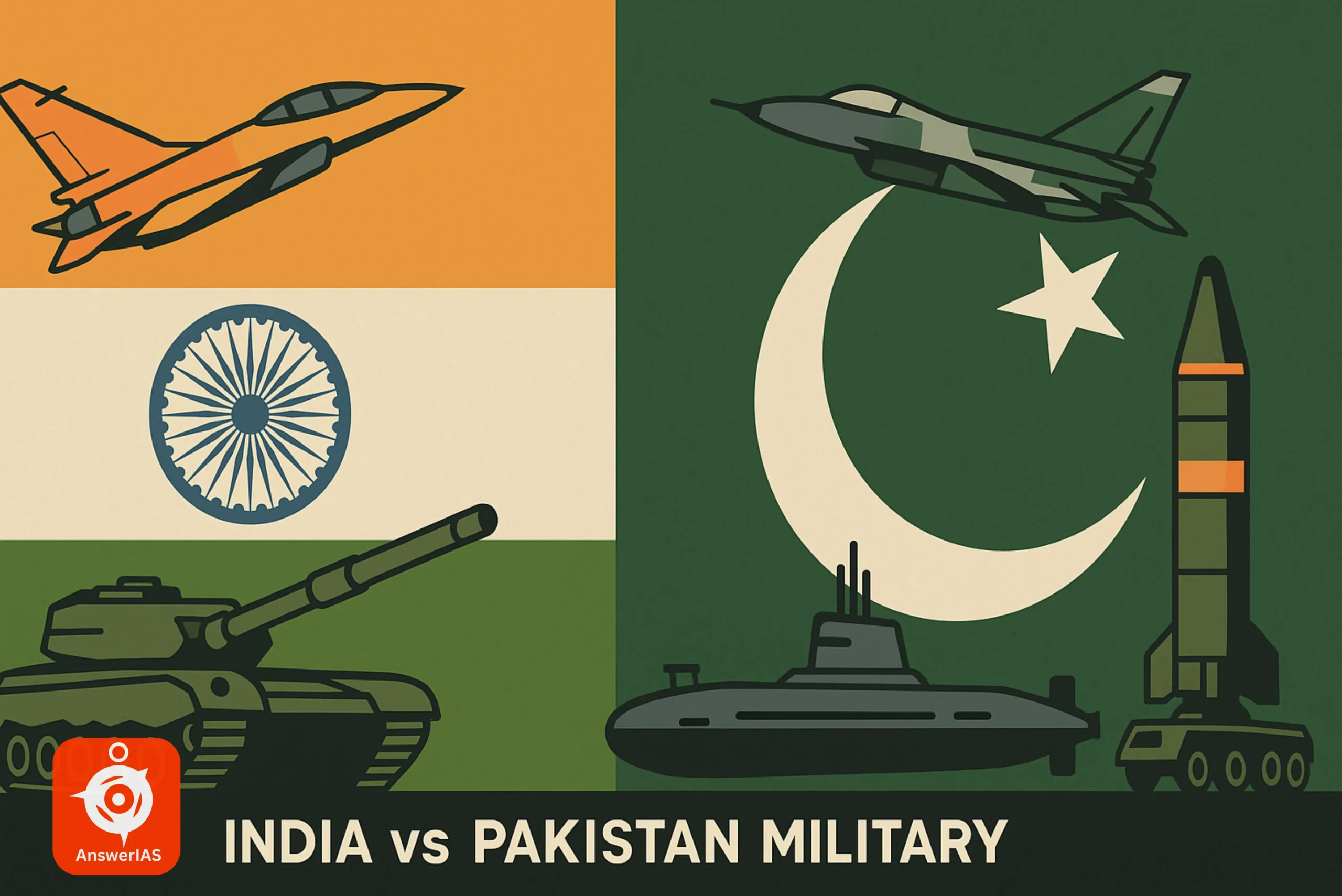
In the ever-evolving landscape of global military power, India and Pakistan stand out as key players in South Asia. Hence India vs. Pakistan Military Comparison is natural . According to Global Firepower’s 2025 index, India ranks as the 4th strongest military worldwide, while Pakistan holds the 12th position. This article delves into a detailed, SEO-optimized comparison of their military capabilities, defense budgets, personnel, air power, land forces, naval strength, missile arsenals, and emerging technologies. We also explore the recent Four-Day Conflict (May 2025) and its implications for the future.
India vs Pakistan Military Power 2025 : Defense Budgets
India’s defense spending stands at approximately US$86 billion, accounting for about 2.3% of its GDP, making it the 5th-largest military spender globally. In contrast, Pakistan allocates around US$10–11 billion, which equates to 2.7–3.6% of its GDP. Following the May 2025 conflict, Pakistan approved a 20% increase in its defense budget (approximately PKR 2.55 trillion or US$9 billion) to bolster its capabilities against future threats.
This significant gap in defense budgets underscores India’s ability to invest heavily in advanced weaponry, infrastructure, and research, while Pakistan focuses on strategic deterrence and cost-effective partnerships, particularly with China.
India vs Pakistan Military Power 2025 : Personnel & Force Size
India’s armed forces are a formidable 5.14 million personnel, nearly three times Pakistan’s 1.7 million. On active duty, India fields approximately 1.4 million troops, compared to Pakistan’s 650,000–700,000. India also benefits from a massive pool of available manpower—662 million compared to Pakistan’s 109 million, providing a strategic edge in prolonged mobilization scenarios.
This disparity in personnel highlights India’s ability to sustain large-scale operations, while Pakistan relies on a leaner, agile force structure optimized for rapid response.
India vs Pakistan Military Power 2025 : Dominance in the Skies
India’s air force operates around 2,229 military aircraft, including advanced platforms like Rafale, Su-30, and MiG-29 variants, supported by cutting-edge air-defense systems such as the S-400 and Akash. Pakistan, with approximately 1,399 aircraft, fields modern fighters like J-10 and JF-17 Block-3, enhanced by Chinese technology and the incoming FC-31 fleet.
India’s superior air fleet size and advanced radar systems provide a significant advantage, particularly in defensive operations, as demonstrated during the May 2025 conflict when S-400 and Akash systems neutralized numerous airborne threats.
Land Forces: Armored Might
India’s land forces boast over 3,151 main battle tanks, including T-90s and the indigenous Arjun Mk 1A, alongside 2,000+ BMP-II infantry fighting vehicles and K9A1 self-propelled howitzers. Pakistan counters with approximately 1,839 MBTs, supported by artillery and infantry units.
India’s numerical and technological superiority in tanks and armored vehicles provides a clear edge in ground warfare, while Pakistan focuses on mobility and localized firepower.
Naval Capabilities: Power on the Seas
India’s navy, with 293 ships, includes two aircraft carriers—INS Vikramaditya and the indigenous INS Vikrant—alongside submarines, destroyers, frigates, and naval aviation assets. Pakistan’s navy, with around 121 vessels, is designed to patrol its 1,046 km coastline, relying on smaller but agile platforms.
India’s carrier task forces, as demonstrated during the 2025 standoff near Karachi, solidify its dominance in maritime power projection, while Pakistan focuses on coastal defense.
Missile & Nuclear Arsenal: Strategic Deterrence
Both nations maintain similar nuclear stockpiles of approximately 160–180 warheads, creating a mutually assured destruction (MAD) environment. India’s missile arsenal includes the Agni-series, BrahMos, Nirbhay, Prithvi, and an emerging hypersonic BM-04. Pakistan counters with Fatah-I/II, ballistic-capable J-35, and the FC-31 fleet.
The balance of nuclear and missile capabilities ensures neither side can dominate strategically, but India’s diverse missile portfolio offers greater flexibility.
Emerging Technologies: The Future of Warfare
The Four-Day Conflict (May 7–10, 2025) highlighted the growing role of drones and cruise missiles. Pakistan deployed Chinese and Turkish drones, while India countered with Israeli-made loitering drones and long-range missiles like BrahMos and SCALP. This marked the first large-scale UAV clash in the region.
India’s S-400 and Akash systems proved effective against airborne threats, while both nations are investing in cyber warfare and AI-powered ISR (Intelligence, Surveillance, Reconnaissance). India’s focus on domestic defense R&D gives it an edge in innovation.
The Four-Day Conflict: A Snapshot
The May 2025 standoff saw intense engagements, including air strikes with BrahMos, SCALP, and Fatah missiles, alongside Pakistani jet engagements and reported aircraft losses on both sides. India’s deployment of INS Vikrant near Karachi showcased its maritime dominance, applying pressure on Pakistan’s coastal defenses.
This brief but intense conflict underscored the shift toward technology-driven warfare, with drones, missiles, and cyber capabilities playing pivotal roles.
India vs. Pakistan Military 2025 Final Outlook
| Domain | India | Pakistan |
|---|---|---|
| Global Ranking | 4th strongest | 12th strongest |
| Budget (USD) | $80–86 billion (2.3% GDP) | $9–11 billion (2.7–3.6% GDP) |
| Personnel | 5.14M total, 1.4M active | 1.7M total, 0.65M active |
| Airfleet | 2,229 aircraft + S-400, Akash | 1,399 aircraft (J-10, JF-17, FC-31) |
| Navies | 293 ships, 2 carriers | 121 vessels |
| Nuclear Arsenal | ~160–180 warheads | ~160–180 warheads |
| Emerging Tech | Advanced missiles, drones, cyber | Drones, ballistic missiles, Chinese tech |
India’s conventional superiority—larger budget, force size, and advanced air-defense systems—positions it as a regional powerhouse. Pakistan, while smaller, leverages strategic deterrence, Chinese partnerships, and an efficient force structure to maintain a credible defense posture. The future of this rivalry lies in technology-heavy standoff capabilities—drones, missiles, and cyber warfare—that will shape military strategies in the coming decade.