Table of Contents
ToggleTopics Covered: Post-GS Strategy for UPSC CSE 2027, Answer Writing During Revision, Answer Evaluation Platforms, Starting Current Affairs/Newspaper, Balancing Optional and GS Revision, Study Plan, Mock Tests, DOs and Don’ts, Timeline Management
There’s a famous quote by Benjamin Franklin that goes, “By failing to prepare, you are preparing to fail” – and this couldn’t be more relevant for UPSC Civil Services Examination aspirants who have just completed their GS foundation.
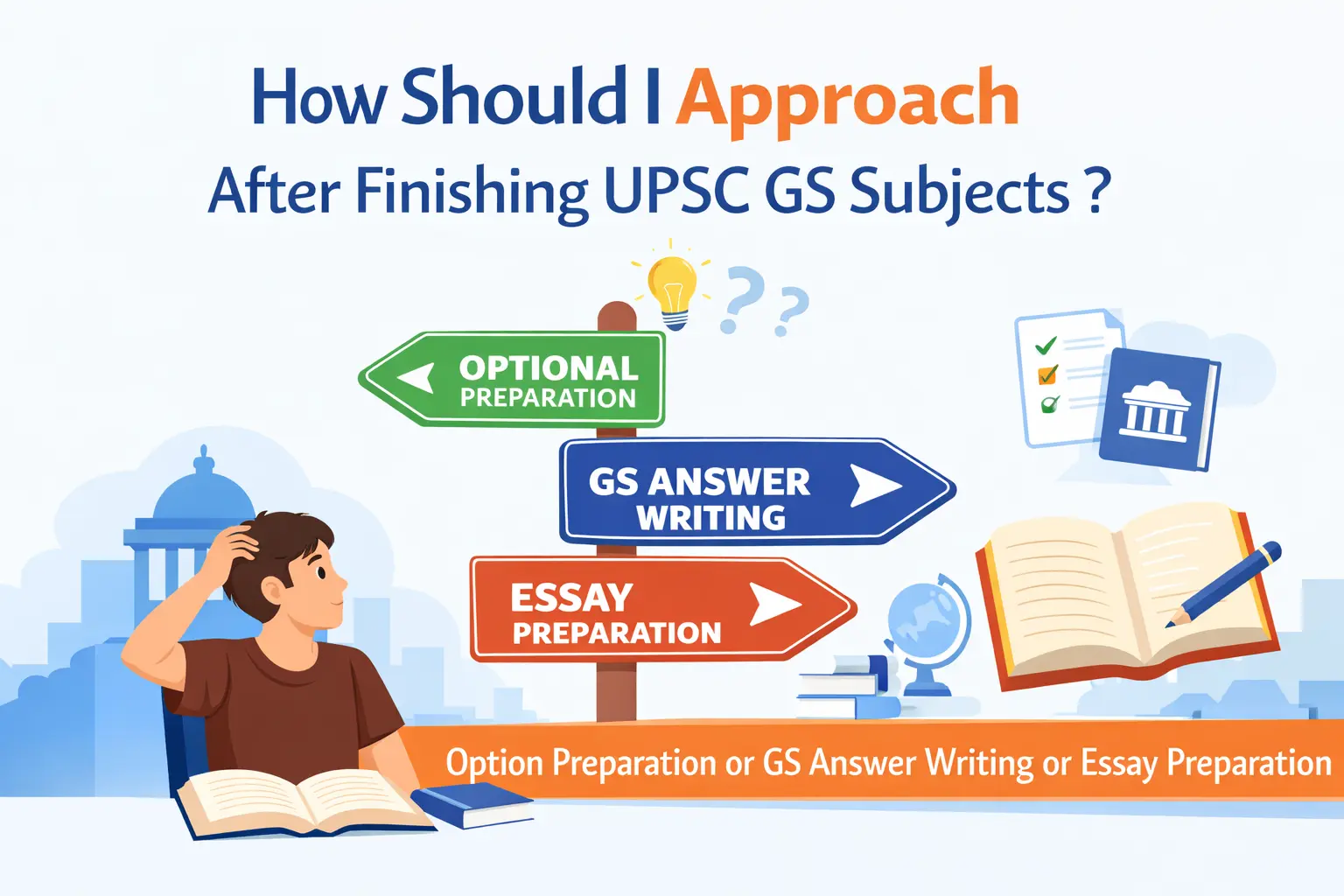
Finishing your General Studies subjects is indeed a major milestone in your UPSC preparation journey. It’s a moment that deserves celebration, but it’s also a critical juncture where many aspirants find themselves at crossroads, wondering about the next steps.
Every year, thousands of aspirants complete their GS syllabus but struggle to optimize the remaining preparation phase. The difference between those who clear UPSC and those who don’t often lies not in how much they studied initially, but in how strategically they utilized the post-GS preparation phase.
As someone who has guided numerous aspirants through this crucial phase, I can confidently say that the period after completing GS is where your preparation truly gets refined and exam-ready.
The transition from foundation building to revision, from optional preparation to integrative answer writing, from passive reading to active current affairs engagement – all these shifts require a well-thought-out strategy.
To help you navigate this critical phase of your UPSC 2027 preparation, I’ll be discussing in detail a comprehensive strategy that covers everything from balancing optional preparation with GS revision, to finding the right answer evaluation platform, to integrating current affairs effectively.
So, without further ado, let’s dive into the Post-GS UPSC Preparation Strategy straightaway.
Understanding Your Current Position
Before we jump into the strategy, let’s understand where you stand right now:
✓ You have completed most GS subjects – this means your foundation is ready
✓ Optional is pending – this is your scoring opportunity waiting to be unlocked
✓ You’re planning to start optional next month while revising GS – smart thinking!
✓ You want to integrate answer writing with revision – absolutely the right approach
✓ You’re looking for quality answer evaluation – critical for improvement
✓ You’re ready to start newspaper – perfect timing
This is actually an ideal position to be in for UPSC 2027. You have adequate time, a solid foundation, and now you need the right execution strategy.
The Balanced Approach Strategy
1. Optional Preparation Timeline
The first principle I want to establish is this: Your optional can be a game-changer in UPSC Mains. With 500 marks at stake in just two papers, optional can significantly boost your overall score.
Since you’re starting optional next month, here’s how you should approach it:
Month 1-2: Foundation Building for Optional
- Dedicate 4-5 hours daily to optional preparation
- Start with understanding the syllabus thoroughly
- Analyze previous year question papers from the last 10 years
- Identify high-weightage topics and frequently asked areas
- Complete the first reading of all topics
Month 3-4: Deep Dive and Consolidation
- Focus on making comprehensive notes
- Integrate standard reference books with current developments
- Start topic-wise answer writing for optional
- Dedicate 3-4 hours daily as GS revision picks up pace
Month 5-6: Revision and Test Series
- Complete second revision of entire optional syllabus
- Take full-length optional test series
- Focus on improving answer quality and presentation
- Reduce time to 2-3 hours daily for optional
2. GS Revision Framework
Now, this is where most aspirants make mistakes. They either over-revise GS at the expense of optional, or they completely ignore GS thinking they’ll cover it later.
Here’s the balanced approach:
Active Revision vs Passive Revision
I call it the RECALL-RETRIEVE-REINFORCE (3R) Method:
- RECALL: Before opening your notes, spend 10 minutes trying to recall the key points of a topic
- RETRIEVE: Open your notes and fill the gaps in your recall
- REINFORCE: Write a 10-marker or 15-marker answer on that topic
This is significantly more effective than just reading notes passively.
GS Revision Schedule:
- Week 1 of every month: GS Paper-1 revision
- Week 2 of every month: GS Paper-2 revision
- Week 3 of every month: GS Paper-3 revision
- Week 4 of every month: GS Paper-4 (Ethics) revision
This ensures you touch every GS paper at least once a month while giving adequate time to optional.
3. Answer Writing Integration
You’ve correctly identified that answer writing during revision is the way to go. Let me tell you why this is brilliant:
Why Answer Writing During Revision Works:
- It converts passive reading into active learning
- You immediately identify gaps in your understanding
- It builds muscle memory for exam conditions
- You develop the ability to recall information under time pressure
How to Integrate Answer Writing:
For GS Papers:
- After revising a topic, immediately write 2-3 questions on it
- Don’t wait to finish the entire syllabus
- Mix 10-markers, 15-markers, and 20-markers
- Time yourself strictly (10 marks = 12-13 minutes, 15 marks = 18-20 minutes)
For Optional:
- After completing a topic, write at least 3-4 questions
- Focus on both descriptive and analytical answers
- Practice diagram-based questions separately
- Maintain a separate answer writing notebook for optional
4. Current Affairs Incorporation
Starting newspaper now is absolutely the right timing. Here’s why:
With GS foundation ready, you can now:
- Connect current affairs to static concepts
- Build integrative understanding
- Develop contemporary examples for answers
- Stay updated for both Prelims and Mains
The Newspaper Reading Strategy (detailed in later section)
Answer Evaluation Platforms (Beyond ChatGPT)
You mentioned you don’t like ChatGPT evaluation – and I completely understand. AI-based evaluation often lacks the nuanced understanding and personalized feedback that human evaluation provides.
Here are the best alternatives for answer evaluation:
1. Mentor-Based Programs
Most coaching institutes and independent mentors offer answer evaluation services. Look for:
- Personalized feedback on content, structure, and presentation
- Comparison with model answers
- Specific suggestions for improvement
- Regular one-on-one discussion sessions
How to Choose:
- Check the mentor’s credentials and success rate
- Look for batch size (smaller is better for personalized attention)
- Ensure regular evaluation cycles (weekly or bi-weekly)
- Read reviews from previous students
2. Peer Evaluation Groups
Form a group of 3-5 serious aspirants:
- Exchange answers weekly
- Evaluate each other based on UPSC marking scheme
- Discuss different approaches to the same question
- Learn from diverse perspectives
How to Make It Work:
- Set clear evaluation criteria
- Use a standardized evaluation sheet
- Be honest but constructive in feedback
- Meet weekly (online or offline) to discuss
3. Online Platforms with Human Evaluators
Several platforms offer:
- Professional evaluators (often ex-bureaucrats or subject experts)
- Detailed written feedback
- Score and improvement suggestions
- Model answers for comparison
Recommended Features to Look For:
- Turnaround time (should be within 48-72 hours)
- Quality of feedback (detailed vs generic)
- Cost-effectiveness
- Additional resources (model answers, test series)
4. Institute Test Series with Evaluation
Many institutes offer comprehensive test series:
- Full-length tests simulating actual exam
- Detailed evaluation by subject experts
- Rank and percentile for self-assessment
- Discussion sessions for important questions
My Recommendation: Use a combination approach:
- Primary: Mentor-based evaluation (2-3 answers per week)
- Secondary: Peer group evaluation (3-4 answers per week)
- Tertiary: Self-evaluation using model answers (daily practice)
The key is consistency and feedback incorporation. Even the best evaluation is useless if you don’t actively work on the feedback.
Detailed Study Plan
Let me give you a month-by-month breakdown for the next 12-14 months leading to UPSC 2027 Mains:
Month 1-2 (Starting from when you begin optional):
Daily Schedule:
| Time | Activity | Duration |
|---|---|---|
| Morning (6:00 AM – 10:00 AM) | Optional Preparation (Fresh Mind) | 4 hours |
| 10:00 AM – 10:30 AM | Break + Quick Revision Flashcards | 30 mins |
| 10:30 AM – 12:30 PM | GS Revision (Following 3R Method) | 2 hours |
| 12:30 PM – 1:30 PM | Lunch + Rest | 1 hour |
| 1:30 PM – 3:00 PM | Newspaper Reading + Current Affairs Notes | 1.5 hours |
| 3:00 PM – 3:30 PM | Answer Writing Practice (GS) | 2-3 questions |
| 3:30 PM – 4:00 PM | Tea Break | 30 mins |
| 4:00 PM – 6:00 PM | Optional Preparation (Continued) | 2 hours |
| 6:00 PM – 7:30 PM | Answer Writing Practice (Optional) | 3-4 questions |
| 7:30 PM – 8:30 PM | Dinner + Family Time | 1 hour |
| 8:30 PM – 10:00 PM | Revision of the Day + Notes Making | 1.5 hours |
| 10:00 PM – 10:30 PM | Weekly Magazine/Monthly Compilation | 30 mins |
Total Effective Study Hours: 10-11 hours
Weekly Targets:
- Complete 1 major topic in optional
- Revise 2 GS topics thoroughly
- Write and get evaluated 15-20 answers
- Complete newspaper reading 6 days a week
- Take 1 sectional test (GS or Optional)
Month 3-4: Consolidation Phase
Shift in Focus:
- Optional: 3-4 hours daily
- GS Revision: 2-3 hours daily
- Answer Writing: 2 hours daily
- Current Affairs: 1.5 hours daily
- Test Analysis: 1 hour (on test days)
Weekly Targets:
- Complete optional syllabus (first revision)
- Finish GS Paper-wise second revision
- Write 20-25 answers per week
- Attempt 2 tests (1 GS + 1 Optional)
Month 5-8: Integration Phase
Key Activities:
- Third revision of both GS and Optional
- Intensive answer writing (25-30 answers per week)
- Full-length mock tests (weekly)
- Current affairs integration with static topics
- Previous year questions practice
Daily Distribution:
- Optional: 2-3 hours
- GS: 2-3 hours
- Answer Writing: 2-3 hours
- Current Affairs: 1.5 hours
- Test/Analysis: 1-2 hours
Month 9-12: Prelims Preparation Phase
Dual Focus Strategy:
- Morning: Prelims preparation (MCQ practice, revision)
- Afternoon: Mains answer writing (to maintain momentum)
- Evening: Optional/GS revision
Post-Prelims to Mains:
- Intensive answer writing practice
- Full-length test series
- Comprehensive revision
- Time management practice
Answer Writing During Revision: The Framework
Let me share a framework that has worked exceptionally well for my students:
The 5-Step Answer Writing Framework:
Step 1: Topic Selection
- Choose the topic you’ve just revised
- Pick questions of varying difficulty levels
- Include PYQs (Previous Year Questions) in your practice
Step 2: Timed Writing
- Set a timer strictly
- Write in exam conditions (no reference material)
- Focus on completion within time limit
Step 3: Self-Evaluation (Immediate)
- Check for factual accuracy
- Assess structure and flow
- Identify missing dimensions
Step 4: Model Answer Comparison
- Compare with standard model answers
- Note additional points you missed
- Observe presentation techniques
Step 5: Rewriting (Selective)
- Rewrite only weak answers
- Incorporate feedback
- Focus on improvement areas
Daily Answer Writing Quota:
| Phase | GS Answers | Optional Answers | Total |
|---|---|---|---|
| Foundation (Month 1-2) | 2-3 per day | 3-4 per day | 5-7 |
| Consolidation (Month 3-4) | 3-4 per day | 3-4 per day | 6-8 |
| Integration (Month 5-8) | 4-5 per day | 3-4 per day | 7-9 |
| Pre-Prelims (Month 9-12) | 2-3 per day | 2 per day | 4-5 |
| Post-Prelims | 6-8 per day | 4-5 per day | 10-13 |
Golden Rules:
- Never skip answer writing even on low-energy days (write at least 2-3)
- Quality over quantity (5 well-evaluated answers > 10 unchecked answers)
- Maintain a separate answer writing notebook with dates
- Track your improvement month-on-month
Newspaper Reading Strategy
Starting newspaper reading now is perfect timing. Here’s how to make it maximally effective:
Which Newspaper to Read:
- Primary: The Hindu (mandatory for UPSC)
- Secondary: Indian Express (for editorials and different perspectives)
- Weekly: Economic & Political Weekly (for in-depth analysis)
How to Read Newspaper:
The 3-Level Reading Strategy:
Level 1: Quick Scan (15 minutes)
- Scan all headlines
- Identify important news
- Mark topics for detailed reading
Level 2: Detailed Reading (45 minutes)
- Read important news thoroughly
- Understand context and implications
- Connect to GS syllabus
Level 3: Note-Making (30 minutes)
- Make concise notes (not copying verbatim)
- Use mind maps or bullet points
- Categorize: GS1, GS2, GS3, Ethics, Essay, Optional
Daily Newspaper Routine:
Morning (Fresh Newspaper):
- Main news section (National, International)
- Editorial page (at least 2 editorials)
- Op-Ed articles
Evening (Revision):
- Quick revision of morning reading
- Make connections with static topics
- Note down potential question areas
Monthly Compilation:
- Week 1 & 2: Daily note-making
- Week 3: Weekly compilation
- Week 4: Monthly consolidation
- Use monthly current affairs magazines as backup (not primary)
Integration with Answer Writing:
For every important topic in newspaper:
- Think: “How can this be asked in Mains?”
- Practice writing at least one question weekly from current affairs
- Link current affairs to static GS topics
Example: News: New semiconductor manufacturing policy announced
Static GS Link:
- GS3: Industrial policy, Make in India, Technology development
- GS2: Government policies, India’s strategic interests
Potential Questions:
- Analyze the significance of semiconductor manufacturing for India’s strategic autonomy
- Critically examine India’s semiconductor policy in the context of global supply chain disruptions
Mock Test Integration
Mock tests are non-negotiable in UPSC preparation. Here’s how to integrate them:
Types of Mock Tests:
1. Sectional Tests (Weekly)
- Topic-wise tests for both GS and Optional
- Time: 1-2 hours
- Purpose: Topic consolidation
2. Paper-wise Tests (Bi-weekly)
- Full GS papers or Optional papers
- Time: 3 hours
- Purpose: Stamina building
3. Full-length Tests (Monthly initially, Weekly from Month 9)
- Complete exam simulation
- Time: 2 days (like actual Mains)
- Purpose: Exam readiness
Mock Test Strategy:
Before Test:
- Revise related topics
- Read previous questions
- Prepare mentally
During Test:
- Strict exam conditions
- No breaks, no references
- Time management practice
After Test:
- Detailed analysis (spend 2x test time on analysis)
- Identify weak areas
- Make improvement notes
- Rewrite weak answers
Analysis Framework:
- Content accuracy: Did you write correct information?
- Coverage: Did you cover all dimensions?
- Structure: Was your answer well-organized?
- Presentation: Was it neat and legible?
- Time management: Did you finish on time?
DOs and Don’ts
DOs:
✓ Start Optional Immediately Don’t delay optional preparation. The earlier you start, the more time you have for revision and integration.
✓ Maintain Consistent Answer Writing Make answer writing a daily non-negotiable habit. Even 2-3 answers daily compound over months.
✓ Integrate Current Affairs from Day One Starting newspaper now is perfect. Make it a daily habit and maintain proper notes.
✓ Get Quality Evaluation Invest in a good answer evaluation service. Unguided practice often reinforces mistakes.
✓ Balance GS and Optional Don’t neglect either. Follow the time distribution guidelines strictly.
✓ Take Regular Tests Mock tests are your reality check. Take them seriously and analyze thoroughly.
✓ Revise Actively (3R Method) Passive reading is ineffective. Always revise with recall, retrieval, and reinforcement.
✓ Maintain Physical and Mental Health Study 10-11 hours daily, but also ensure 7-8 hours sleep, exercise, and relaxation.
✓ Track Your Progress Maintain a progress tracker for syllabus coverage, answer writing, and test scores.
✓ Stay Flexible If something isn’t working, be willing to adjust your strategy.
DON’Ts:
✗ Don’t Delay Optional Many aspirants keep delaying optional thinking they’ll start after complete GS revision. This is a mistake.
✗ Don’t Over-Rely on AI Evaluation ChatGPT and AI tools have limitations. Human evaluation provides nuanced feedback.
✗ Don’t Just Read Newspaper Reading without note-making and integration is passive consumption. Be active.
✗ Don’t Skip Test Analysis Taking tests without proper analysis is useless. Analysis is where real learning happens.
✗ Don’t Neglect GS Revision While focusing on optional, don’t completely stop GS revision. Weekly revision is must.
✗ Don’t Copy Model Answers Verbatim Understand the approach, don’t memorize answers. UPSC values original thinking.
✗ Don’t Join Too Many Test Series 1-2 good test series are enough. Too many tests lead to anxiety without improvement.
✗ Don’t Compare with Others Everyone’s preparation journey is different. Focus on your own progress.
✗ Don’t Ignore Feedback If multiple evaluators point out the same issue, work on it immediately.
✗ Don’t Compromise on Sleep All-nighters and irregular sleep patterns destroy retention and health.
Timeline Management for UPSC 2027
Since you’re preparing for UPSC 2027, let’s create a realistic timeline:
Current Position: March-April 2025
- GS foundation complete
- Starting optional preparation
Phase 1: April-September 2025 (6 months)
Goal: Complete optional + Continuous GS revision + Answer writing foundation
- Month 1-2: Optional foundation + GS first revision cycle
- Month 3-4: Optional consolidation + GS second revision cycle
- Month 5-6: Optional revision + GS third revision cycle
- Answer Writing: Build from 5 to 8 answers per day
- Current Affairs: Establish newspaper reading habit
Phase 2: October 2025-May 2026 (8 months)
Goal: Prelims 2026 preparation + Maintain Mains readiness
- October-December: Prelims focused preparation begins
- January-March: Intensive Prelims preparation
- April-May: Final Prelims push + Mains answer writing maintenance (4-5 answers daily)
Phase 3: June-September 2026 (4 months)
Goal: Intensive Mains preparation
- June: Comprehensive revision + Answer writing intensification
- July-August: Test series + Refinement
- September: Final revision + Mock tests
- Target: 10-12 answers daily
Phase 4: October 2026 onwards
Goal: Interview preparation (if you clear Mains)
- DAF preparation
- Mock interviews
- Current affairs update
- Personality development
Key Milestone Dates for UPSC 2027:
- Prelims 2026: May 2026 (qualifying for Mains 2026/Interview 2027)
- Mains 2026: September 2026
- Interview 2027: February-April 2027
- Final Result: May-June 2027
Study Sequence
To make it more actionable, here’s your step-by-step study sequence:
Step 1: Set Up Your Systems (Week 1)
- Download and organize optional syllabus and PYQs
- Get optional standard books and resources
- Enroll in an answer evaluation program or form peer group
- Subscribe to The Hindu (physical/digital)
- Set up a study tracking system
- Create a dedicated study space
Step 2: Begin Optional (Month 1)
- Analyze PYQs of last 10 years
- Identify high-weightage topics
- Start with topics you find interesting/easy
- Make comprehensive notes
- Begin topic-wise answer writing after each topic
Step 3: Parallel GS Revision (Month 1 onwards)
- Follow weekly GS paper-wise revision schedule
- Use 3R Method (Recall-Retrieve-Reinforce)
- Write 2-3 GS answers daily
- Integrate with current affairs
Step 4: Current Affairs Integration (Month 1 onwards)
- Read The Hindu daily (morning)
- Make categorized notes (30 mins daily)
- Weekly compilation of important issues
- Monthly consolidation
- Practice CA-based questions weekly
Step 5: Answer Writing Acceleration (Month 2 onwards)
- Increase daily answer count gradually
- Get weekly evaluation (minimum 10-15 answers)
- Maintain feedback diary
- Rewrite weak answers
- Compare with toppers’ answers
Step 6: Test Series Integration (Month 3 onwards)
- Start with sectional tests (weekly)
- Progress to paper-wise tests (bi-weekly)
- Full-length mocks (monthly, then weekly)
- Spend double time on analysis
- Track improvement metrics
Step 7: Continuous Refinement (Ongoing)
- Weekly review of what worked and what didn’t
- Adjust strategy based on results
- Identify and work on weak areas
- Maintain consistency
- Stay motivated and focused
Conclusion
As we conclude this comprehensive guide, I want to emphasize that completing your GS subjects is just the beginning of your transformation into an IAS officer. The real work starts now – in how you integrate optional preparation, refine your answer writing, stay updated with current affairs, and consistently improve through quality feedback.
The strategy I’ve shared with you is based on the success patterns of numerous toppers and my years of experience in guiding UPSC aspirants. But remember, no strategy works unless you execute it with discipline and dedication.
Your concern about answer evaluation beyond ChatGPT shows maturity in understanding that quality feedback is crucial. Your plan to start newspaper reading now is perfectly timed. Your intention to write answers during revision is spot-on.
You have all the right instincts. Now you need the right execution.
For UPSC 2027, you have adequate time. Use it wisely:
- Don’t rush through optional
- Don’t neglect GS revision
- Write answers daily without fail
- Get quality evaluation consistently
- Stay updated with current affairs
- Take tests and analyze thoroughly
- Most importantly, believe in the process
Remember: UPSC is a marathon, not a sprint. Consistency beats intensity. Daily small improvements compound into extraordinary results.
I have complete faith that if you follow this strategy with dedication, UPSC 2027 will be yours.
Stay focused, stay consistent, and give it your all!
Your civil services dream is waiting for you. Go get it!
Keep Learning!
FAQs: Post-GS UPSC Preparation Strategy
1. How many hours should I dedicate to optional preparation daily?
In the initial months, dedicate 4-5 hours to optional. As you progress and complete your first reading, reduce it to 3-4 hours, and in the final months maintain 2-3 hours for revision. The key is consistent preparation rather than intensive bursts.
2. Should I complete optional first or do GS revision and optional together?
The balanced approach works best. Dedicate mornings to optional (fresh mind), and afternoon/evening to GS revision. This ensures you don’t forget GS while building your optional, and you don’t delay optional preparation.
3. Where should I get my answers evaluated if I don’t want to use ChatGPT?
You have several options:
- Enroll in mentor-based evaluation programs from reputed institutes
- Form peer evaluation groups with serious aspirants
- Join online platforms with human evaluators (ex-bureaucrats/experts)
- Take comprehensive test series with detailed evaluation
The best approach is a combination: primary mentor evaluation (2-3 answers/week) + peer group evaluation (3-4 answers/week) + self-evaluation using model answers (daily).
4. When should I start reading newspaper for UPSC preparation?
If you’ve completed GS foundation, now is the perfect time to start newspaper reading. With GS foundation ready, you can connect current affairs to static topics effectively. Reading newspaper before understanding static GS is less effective.
5. How many answers should I write daily?
Start with 5-7 answers daily (2-3 GS + 3-4 Optional) in initial months. Gradually increase to 8-10 answers by Month 3-4. Post-Prelims, aim for 10-13 answers daily. Remember: quality matters more than quantity.
6. How should I balance answer writing with optional preparation and GS revision?
Follow this daily distribution:
- Optional preparation: 4 hours (reducing to 2 hours by Month 5-6)
- GS revision: 2-3 hours (using 3R Method)
- Answer writing: 2-3 hours (both GS and Optional)
- Current affairs: 1.5 hours
- Test/Analysis: 1-2 hours (on test days)
7. Is it necessary to take mock tests from the beginning?
Yes, but start with sectional/topic-wise tests initially (from Month 2-3). These help consolidate topics. Start full-length mocks from Month 5-6, initially monthly, then bi-weekly, and finally weekly as you approach Mains.
8. How many times should I revise GS before Mains?
Aim for at least 3-4 comprehensive revisions before Mains. Use the monthly cycle: each month, revise all four GS papers once. This ensures multiple revisions while maintaining freshness.
9. Should I make separate notes for current affairs or integrate with GS notes?
Do both. Make daily current affairs notes categorized by GS papers. Then, monthly, integrate important topics with your static GS notes. This creates linkages and helps in answer writing.
10. How do I know if my answer writing is improving?
Track these metrics:
- Evaluation scores (are they increasing?)
- Number of dimensions covered (improving?)
- Time management (are you finishing within time?)
- Presentation quality (getting better?)
- Feedback frequency (are you making the same mistakes or new ones?)
Maintain a progress tracker and review monthly.
11. What if I’m not able to complete the daily schedule?
Don’t panic. Be flexible. The schedule is a guideline, not a straitjacket. If you miss daily targets, adjust and catch up over the weekend. Keep weekly targets as non-negotiable, but daily tasks can be flexible.
12. Should I join multiple test series?
No. 1-2 good test series are sufficient. Too many tests lead to:
- Analysis paralysis
- No time for proper analysis
- Anxiety without improvement
- Inconsistent evaluation standards
Choose quality over quantity.
13. How detailed should my current affairs notes be?
Keep them concise and categorized:
- Fact-based issues: bullet points
- Analytical topics: 1-2 paragraphs
- Important reports/data: key points only
- Editorials: main argument + 3-4 supporting points
Avoid copying newspaper verbatim. Make notes you can actually revise.
14. When should I start Prelims preparation alongside Mains preparation?
From October-November 2025, start dedicating morning hours to Prelims while maintaining Mains answer writing in evening. This dual preparation ensures you don’t forget answer writing skills during Prelims focused months.
15. What if my optional and GS have overlapping topics?
This is an advantage! When topics overlap:
- Prepare them together
- Use optional depth for GS answers
- Use GS breadth for optional perspective
- Save preparation time
- Strengthen both simultaneously
16. How important is answer evaluation compared to just writing more answers?
Evaluation is MORE important than volume. Writing 50 answers without evaluation is less useful than writing 20 well-evaluated answers. Unguided practice often reinforces mistakes. Always prioritize quality and feedback over mere quantity.
17. Can I completely rely on monthly current affairs magazines instead of daily newspaper?
No. Daily newspaper reading develops:
- Daily reading habit
- Connection with current issues
- Writing material from diverse perspectives
- Interview preparation foundation
Use monthly magazines as backup/consolidation, not as primary source.
18. How many hours of study are optimal for UPSC preparation?
10-11 hours of effective study is optimal for serious preparation. This includes:
- Active study: 8-9 hours
- Answer writing: 2-3 hours
- Revision: 1-2 hours
- Test analysis: 1-2 hours (on test days)
More important than hours is consistency and effectiveness.
19. What if I feel demotivated or face a slump in preparation?
This is normal. Everyone faces it. When it happens:
- Take a strategic break (1-2 days)
- Reflect on your ‘why’
- Talk to mentors/peers
- Read success stories
- Start fresh with renewed energy
- Don’t let it extend beyond 2-3 days
UPSC is a long journey. Temporary slumps are part of it.
20. Is this strategy applicable for all optionals or just specific ones?
This strategy is broadly applicable for all optionals. However, adjust based on:
- Subject nature (factual vs analytical)
- Your background (familiarity level)
- Syllabus size (some optionals are larger)
- Your strengths (some may need more/less time)
The core principles remain the same: balanced preparation, consistent answer writing, quality evaluation, and systematic revision.