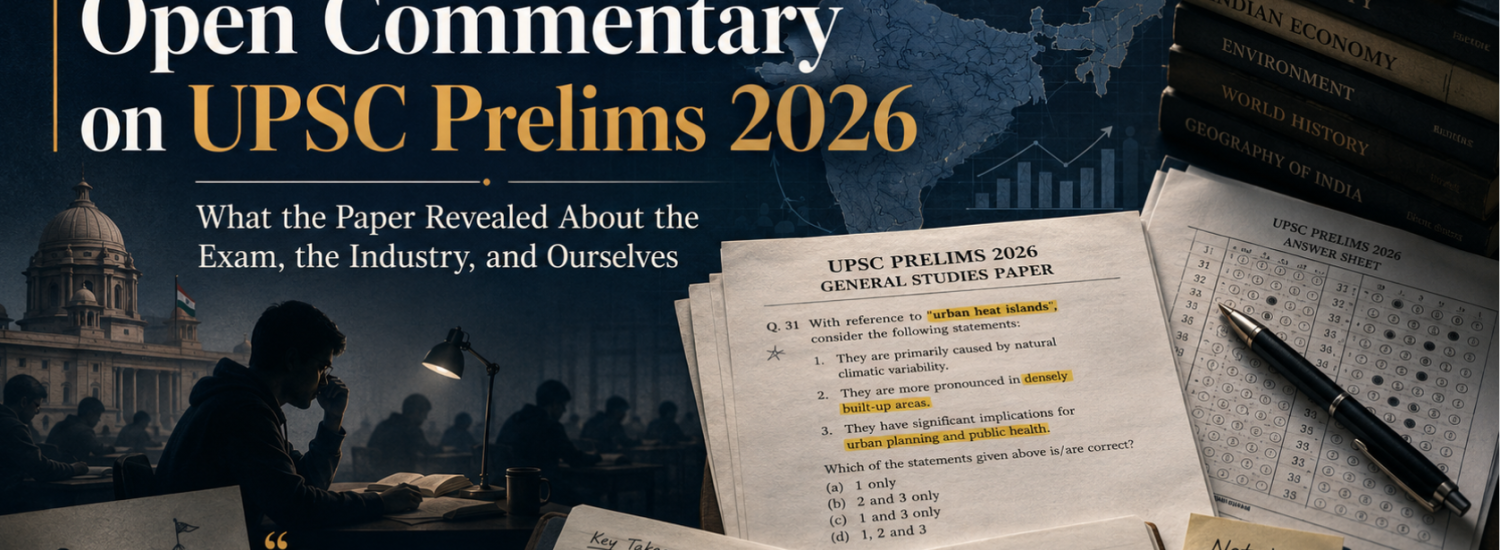
What the Paper Revealed About the Exam, the Industry, and Ourselves
A few hours after the UPSC Civil Services Preliminary Examination 2026 ended, the country’s most disciplined student community did something it usually does not do. It stopped pretending.
In Telegram groups, on YouTube comment threads, on X, in WhatsApp study circles, the conversation was not the usual mix of “attempted 78, hoping for the best” and “let’s wait for the cutoff.” It was rawer than that. Aspirants were not just venting; they were diagnosing. They were not just disappointed; they were articulating a structural argument against the way an entire ecosystem — the Commission, the coaching market, the content economy, and even the aspirant’s own self-image — has been operating.
This article is an attempt to take that open commentary seriously. Not to amplify the outrage, but to read it carefully. Because if you listen past the anger, what aspirants are saying about Prelims 2026 is not merely that the paper was hard. They are saying that something more fundamental has cracked.
Let us walk through what cracked, and why it matters.
1. It Was Not Just a Tough Paper. It Broke the Trust Contract.
The first temptation, especially for those defending the Commission, will be to flatten the criticism into a familiar shape: students are crying because the paper was tough. This framing is convenient because it is easy to dismiss. Of course UPSC is tough. Of course it is meant to be tough. That is the whole point of a competitive exam where lakhs compete for hundreds of seats.
But the aspirants themselves have been remarkably precise in rejecting this framing. The recurring formulation in comments has been some version of: Difficulty, yes. Irrelevance, no. Or as one aspirant put it bluntly, “Competitive papers are meant to be tough. The issue was that this paper was so random, so illogical.”
This is an important distinction, and the blog version of the truth should not let it collapse. A paper can be brutally difficult and still fair. Fairness in a competitive exam does not mean easy. It means there is a discoverable logic — a pedagogic spine — between what the syllabus promises, what the past papers signal, and what is finally asked. When that spine is intact, even a difficult paper rewards the serious student.
What aspirants are saying about Prelims 2026 is that this spine bent in ways that no amount of honest preparation could have anticipated. Questions appeared to be drawn from corners so obscure that they read less like an assessment of an aspirant’s general awareness and more like a trivia round. The exam, in their telling, did not test depth. It tested whether you happened to have stumbled across a particular footnote.
This is why the more accurate framing is not “tough paper” but “broken trust contract.” When you commit two, three, sometimes five years of your life to an exam, you are implicitly trusting that the rules of the game will remain coherent. The 2026 paper, for many aspirants, violated that coherence. That is a different and more serious charge than mere difficulty.
2. PYQs Are a Compass, Not a Crystal Ball
Closely related, and perhaps the most discussed symptom of the broken contract, is the collapse of the Previous Year Question Paper as a predictive tool. Comments like “no reference with previous years papers” and the more colourful “Importance of PYQs gaya tel lene” have flooded the feed.
Here, the temptation is to overcorrect. Some loud voices are already saying PYQs are useless, that aspirants wasted their time, that the entire PYQ industry is a fraud. This is the wrong lesson.
PYQs were never supposed to be a crystal ball. They were a diagnostic tool. They helped the aspirant understand how UPSC frames a question, what level of nuance it expects, how it disguises easy answers as tough ones and tough ones as obvious. PYQs were valuable for the same reason that studying old chess games is valuable — not because the position will repeat, but because the thinking repeats.
What has gone wrong is not that aspirants used PYQs. It is that the PYQ became an industry, a “compilation product” sold and resold, drilled and re-drilled, until aspirants began treating it as a syllabus replacement. They were not preparing for UPSC; they were preparing for a statistical shadow of UPSC. And then the shadow moved.
The post-2026 lesson is not “abandon PYQs.” It is “reinstate PYQs to their original role.” A compass, not a crystal ball. A way to read direction, not a way to predict destination.
3. When Everything Is Syllabus, Nothing Is Syllabus
The third infection in the discourse is what we can call infinite syllabus syndrome. Aspirants have been demanding, with increasing despair, that UPSC define its syllabus properly. The point that “syllabus ka bhi kuch moolya hota hai” — the syllabus must mean something — is being made not out of laziness but out of survival.
Defenders of obscure questions often argue that everything is technically inside the General Studies umbrella. Botany. Obscure historical persons. Marginal schemes. A footnote from a 2019 PIB release. After all, General Studies is general.
But this is sophistry, and aspirants know it. If everything can be defended ex post as part of “general awareness,” then the syllabus has stopped functioning as a syllabus. It has become a rhetorical alibi for unpredictability. The aspirant is forced into a kind of epistemic horror: the more she studies, the more she discovers what she does not know. The library expands faster than she can read.
This is psychologically corrosive and economically unsustainable. The point of a syllabus is not to enable laziness; it is to create a boundary of reasonable expectation. When that boundary dissolves, preparation becomes anxiety with a study schedule attached.
4. The Paper That Put Coaching Certainty on Trial
If aspirants are turning on the Commission, they are turning on the coaching industry with equal energy — and arguably with more justification.
For over a decade, the coaching market has packaged itself as the engineer of smart preparation. The promises were specific: this PYQ analysis, this topic weightage, these expected areas, these probable questions. Smart preparation was sold as the antidote to mindless effort. The promise was that with the right strategy, the right notes, the right test series, the aspirant could decode UPSC.
The 2026 paper has placed this entire promise on trial. As one aspirant put it: coaching sold “smart preparation,” and a single paper proved that the analysis could fail in one day. Another observed, with quiet devastation, that even the coaching teachers themselves did not have confirmed answers immediately after the paper.
The deeper point here is uncomfortable. Many aspirants were not just unprepared for UPSC. They were over-prepared for coaching’s version of UPSC. They had become extremely good at solving a model of the exam that did not match the exam itself. This is not a small distinction. It is the difference between training for a marathon and training for a video game called marathon.
The coaching industry will not disappear after this paper. But the unstated trust between teacher and student has shifted. The aspirant will now be more skeptical of confident claims, of “must-do” lists, of post-facto rationalisations, of teachers who solve the paper in teams over hours and then critique students who had to do it alone in two.
5. The UPSC Industry Has a Trust Problem
This skepticism is not limited to coaching. It now extends to the larger UPSC content economy — the YouTubers, the test-series sellers, the answer-key competitors, the cutoff predictors. Aspirants are increasingly seeing this ecosystem not as a neutral support system but as an industry that monetises uncertainty before the exam (through anxiety) and after the exam (through confusion).
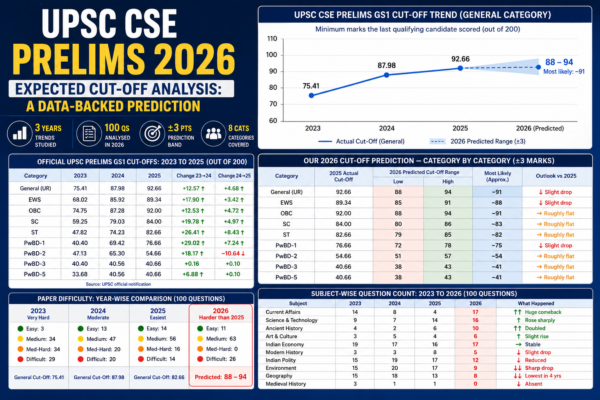
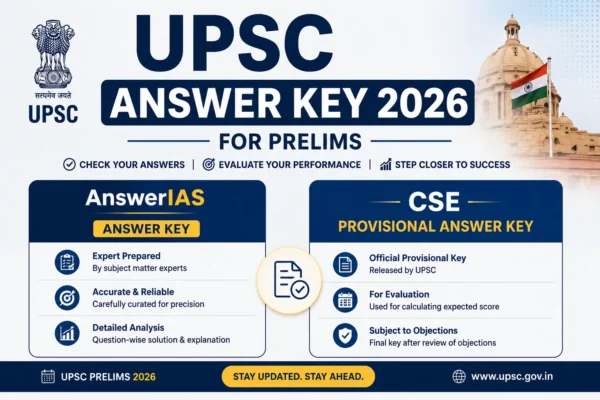
After Prelims 2026, multiple answer keys appeared with conflicting answers to disputed questions. Each major institute released its key with confidence, and each contradicted the others on key items. Cutoff predictions, often presented as data-driven, swung wildly within twenty-four hours.
The aspirant is left to ask a question that no one quite wants to answer: if you are the experts, why don’t you agree? And the deeper version of that question: who benefits from this confusion?
6. The Exam Ends in Two Hours. The Uncertainty Begins After That.
This leads naturally to a separate and underexamined crisis: the post-exam vacuum.
A paper is written in two hours. Then the candidate enters a multi-week, sometimes multi-month, fog. Different keys say different things. The Commission does not release the OMR sheet in real time. The “official” key arrives only after the result. Until then, the aspirant is asked to make life decisions — Mains preparation, financial planning, family conversations — based on a probability estimate built on rumours.
The infection here is opaque evaluation. In an exam that demands such ferocious transparency from its candidates, the asymmetry of information after the paper is striking. The candidate writes in full visibility; the evaluator marks in full obscurity.
This is not a small operational complaint. For aspirants whose mental health is already strained, the period between the paper and the official key has become a slow leak of stability.
7. The Qualifying Paper That Is Quietly Eliminating Serious Aspirants
While the GS paper has dominated the post-exam noise, a quieter tragedy is playing out in the CSAT paper. Comment after comment tells a similar story: “GS manage tha, CSAT me lag gaye.” GS was manageable; CSAT finished me.
For years, CSAT has been treated as a qualifying paper — a 33% threshold, an afterthought, a last-month formality. The mythology has been that any reasonably literate graduate can clear it with a few mock tests.
That mythology is dead. CSAT has become the silent executioner of serious aspirants. Non-mathematics-background students, humanities aspirants, Hindi-medium candidates, working professionals returning to study after years away from quantitative aptitude — they are being cut by a paper they were taught not to fear.
The blog version of the truth is this: CSAT must be re-classified in the aspirant’s mind. Not as a side paper, but as a primary battleground. The “qualifying” label is misleading. What qualifies you cannot, by definition, also be the thing that disqualifies you in large numbers. And yet that is precisely what is happening.
8. Who Can Afford an Unpredictable UPSC?
If the previous themes were about pedagogy and method, the next is about justice.
Among the most powerful threads in the aspirant commentary is one written, often in painful detail, by candidates from lower-middle-class, rural, and Hindi-medium backgrounds. They speak of leaving home, of fighting parents who do not understand why a “good son” is not yet earning, of arranging coaching fees that strain household budgets, of staking everything — youth, savings, marital prospects, family peace — on a single bet.
For these aspirants, unpredictability is not an intellectual annoyance. It is an existential threat.
A wealthy aspirant can absorb a bad paper. He can take another attempt, hire better tutors, switch to a premium test series, give a second year without financial panic. He can afford to be unlucky.
A lower-middle-class aspirant often cannot. One unpredictable paper does not just push back his timeline; it can end his attempt at this profession altogether.
This is the question that the system rarely confronts honestly: Does unpredictability disproportionately punish those who cannot afford endless attempts? If the answer is yes — and the aspirant commentary suggests it is — then this is not just an exam design problem. It is a social mobility problem dressed in the language of meritocracy.
The romance of UPSC has always been that it is the great equaliser. A village teacher’s son can become a Collector. That story is not dead, but it is becoming more expensive to live.
9. When Hard Work Meets Tukka
The aspirant community has always had a quiet pact with itself: if I work hard enough, I will get through. The 2026 paper has bruised that pact. The word “tukka” — informed guessing — appears with new prominence in the commentary. “Tukka > knowledge,” some say. “Prelims is a test of luck not skill,” say others.
The instinct, especially among well-meaning seniors and motivational speakers, will be to push back. Don’t blame luck. Blame your preparation. Hard work always pays.
This is well-intentioned and partly wrong.
The more honest and useful formulation is this: hard work improves probability. Volatility, however, is real. Modern Prelims contains a layer of unpredictability that cannot be eliminated by preparation alone. The aspirant’s skill set must therefore include not just knowledge, but volatility management — elimination strategy, calibrated guessing, risk tolerance under uncertainty, emotional regulation during the paper.
To deny the role of luck is to gaslight the aspirant. To surrender to luck is to give up. The correct posture is to acknowledge volatility honestly and then build a preparation method that hedges against it.
10. Is Prelims Still Screening Serious Candidates?
A more philosophical theme is now entering the conversation. Several aspirants, especially repeat candidates with solid Mains preparation, report a peculiar betrayal: they were Mains-ready, sometimes more than ready, and yet were filtered out by a screening test that they believe did not screen for the qualities that actually matter for a civil servant.
This raises a design question that the Commission may not want to ask, but must: Is Prelims still serving its declared purpose?
Prelims is, by definition, a screening test. Its job is to narrow the field so that Mains and the Interview can do the deeper evaluation. But if Prelims becomes so volatile that it filters not for seriousness, depth, or aptitude but for the ability to guess obscurities, then it is no longer screening serious candidates. It is eliminating them randomly.
A screening filter that filters out the wrong people is not a filter. It is a lottery with a syllabus.
11. After UPSC 2026, the Real Question Is Not ‘What Was Asked?’ but ‘How Should We Study Now?’
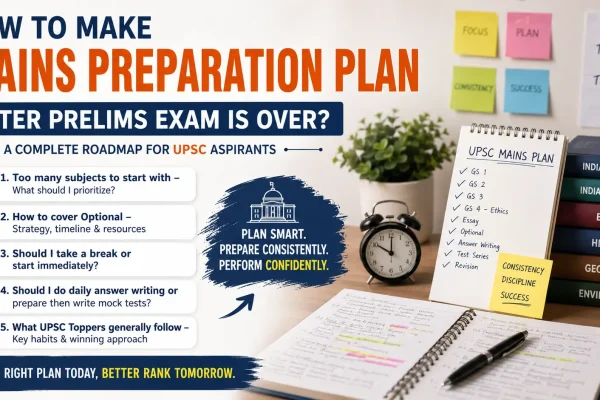
Underneath the anger, the most useful signal in the aspirant commentary is operational. Aspirants are asking what to do next. How to approach different subjects for 2027. What core areas still deserve emphasis. Whether the trend of vagueness will continue or correct. Whether the syllabus must be rebuilt from scratch.
This is not a cry for motivation. It is a demand for method reset.
A serious post-2026 preparation framework will likely have to combine five elements:
A renewed respect for the static core — Constitution, governance, economy fundamentals, modern history, physical and Indian geography — not as a fashionable area but as the spine that keeps the candidate upright when the paper goes weird.
A disciplined relationship with current affairs, treating them as application material rather than a list of factoids, focusing on why something matters rather than what its launch date was.
Applied reasoning — the ability to take half-known information and arrive at probable answers through logic, exclusion, and inference. This is the muscle that handles volatility.
Elimination under uncertainty as a tested skill, practiced through mocks designed to mimic the new paper’s irrationality, not the old paper’s predictability.
Source discipline — fewer sources, deeper readings, and a refusal to chase every new compilation that appears in the market.
This is not a glamorous framework. It will not sell as well as “Top 100 PYQ Areas.” But it is more honest, and more durable.
12. UPSC or Nothing Is Now a Dangerous Strategy
The hardest theme to write about, because it punctures the most cherished myth, is the career-risk conversation that has now entered the aspirant mainstream.
For years, the dominant narrative around UPSC was emotional — if you really want it, give it everything. Don’t have a Plan B, because Plan B distracts you from Plan A. Coaching marketing has fed this romance, because the “all-in” aspirant is the most loyal customer.
The 2026 paper has done something that no motivational poster could undo. It has forced aspirants to acknowledge, in their own words, that “UPSC or nothing” is now a dangerous strategy. Comments openly discuss shifting to State PCS, taking a job first, attempting UPSC only after financial security, not wasting one’s youth on a probability event that has become harder to forecast.
The most quoted version of this advice now comes from lower-middle-class aspirants themselves: Get a job first. UPSC has changed. Only financially strong candidates can survive multiple attempts.
This is not surrender. This is risk management. A serious aspirant in 2026 should not be asking how do I bet everything on this exam? She should be asking how do I prepare seriously while keeping my life intact?
The bravest post-2026 aspirant is not the one who quits everything to chase a dream. It is the one who refuses the false choice between ambition and security, and builds a life where preparation is one important pillar, not the only pillar holding up the roof.
A Closing Note: The Exam Has Changed. The Conversation Should Too.
What is striking about the open commentary on Prelims 2026 is not its anger. Exams have always produced anger. What is striking is its coherence. Aspirants are not just complaining; they are theorising. They are diagnosing the disease, not just describing the fever.
The Commission will do what it does. The coaching industry will adjust its packaging. The content economy will produce new compilations, new keys, new cutoff predictions, new “must-watch” videos. The machinery will move on.
But the aspirant — the actual human being at the centre of all this — has a chance to come out of this paper smarter, not just sadder. The lessons are available, if she is willing to read them honestly.
Prelims is no longer purely a knowledge filter. It contains a volatility layer that must be managed.
PYQs are a compass, not a crystal ball.
The syllabus is now everything, which means the aspirant must rebuild her own boundaries.
Coaching certainty is, at best, a probability claim.
CSAT is not a side paper. It is a primary battleground.
The system disproportionately rewards those who can afford to be unlucky, and the honest answer to that is structural, not individual.
And finally — the most adult lesson of all — UPSC is one of life’s biggest exams, but it is not the only one. The candidate who recognises this is not less serious. She is more.
Prelims 2026 will be remembered for many things. If it is remembered for one thing that matters, let it be this: it was the paper that finally forced an honest conversation. Not just about the exam, but about the entire culture built around it.
And honest conversations, however painful, are how systems heal.