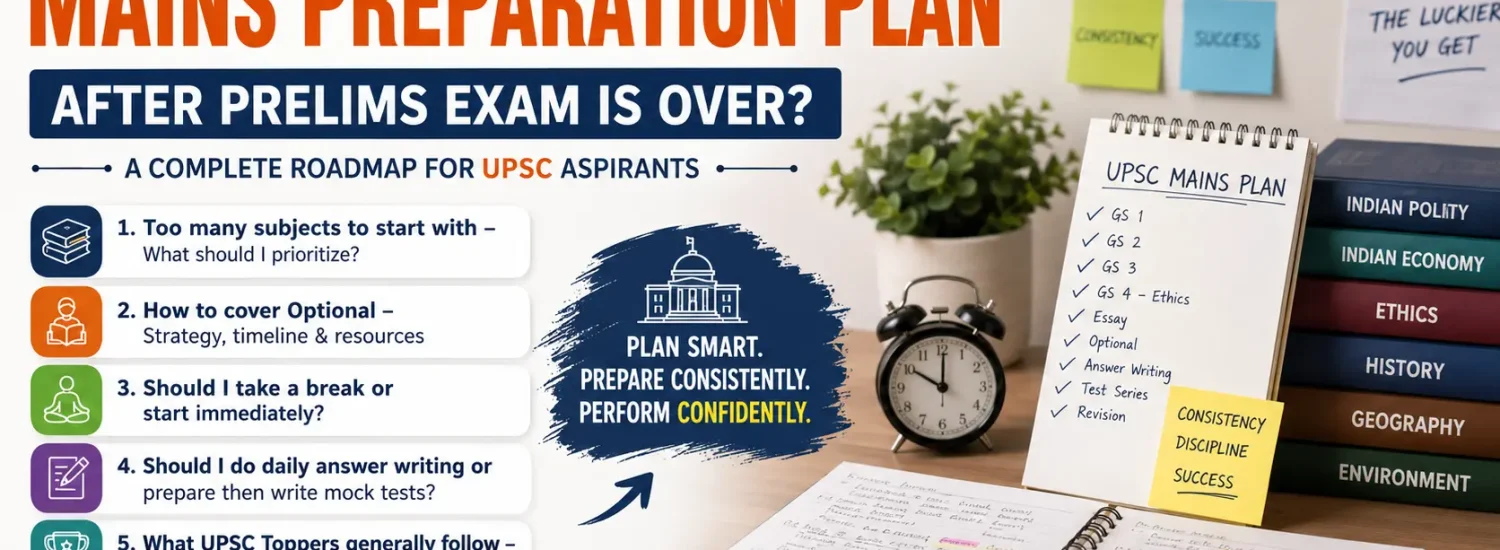
The moment you walk out of the Prelims hall after UPSC Prelims 2026, a strange silence descends. Months of grinding through NCERTs, current affairs compilations, and PYQs suddenly pause, and a much bigger mountain reveals itself: the Mains. For UPSC Prelims 2026 aspirants, the next 90 to 100 days will decide far more than the Prelims ever did. Mains is where ranks are made, optional subjects either lift you up or pull you down, and your ability to write under pressure becomes the single most important skill in your arsenal.
The problem most aspirants face is not lack of effort. It is confusion. Should you start with GS or Optional? Should you take a break or jump straight into revision? Should you write answers from Day 1 or wait until you have revised everything? And what exactly do toppers do that others miss? This guide walks you through a realistic, honest Mains preparation plan that respects both the syllabus and your sanity.
Should You Take a Break After Prelims?
The temptation after Prelims is real. You want to sleep for three days, watch a season of something on Netflix, meet friends, eat food that is not from a tiffin service, and pretend UPSC does not exist. On the other hand, social media is flooded with serious aspirants who claim they started Mains preparation the very next morning. Both extremes are wrong.
A long break of one or two weeks is dangerous. The Mains syllabus is enormous, and every lost day compounds into stress later. But starting immediately, with your brain still fried from Prelims tension, is equally counterproductive. You will sit at your desk staring at Ethics case studies and absorb nothing.
The sensible middle path is a short reset of two to three days. Use this time to sleep properly, exercise, eat well, meet family, and clear your head. Do not touch books. Do not check answer keys obsessively. Do not calculate your Prelims score on forty different platforms. By Day 3 or Day 4, your mind will naturally feel restless and ready to engage again. That restlessness is your signal to begin.
One important point: do not wait for Prelims results before starting Mains preparation. The gap between Prelims and Mains is too short to afford that luxury. Assume you have cleared, and prepare as if Mains is non-negotiable. Even if the result goes the other way, the preparation you do now will pay off next year.
What to Start First After Prelims
This is where most aspirants freeze. GS Paper 1, GS 2, GS 3, GS 4, Essay, Optional, current affairs, answer writing, test series. Where do you even begin? The honest answer is that you cannot do everything in the first week, and trying to do so guarantees burnout by Week 3.
The right starting point is your Optional subject. The reason is simple. Optional carries 500 marks and is the most underprepared area for most candidates because Prelims preparation crowds it out. By the time Prelims ended, your Optional has likely been neglected for two to three months. It needs revival first, not last.
Spend the first ten to fifteen days primarily on Optional. Revise your notes, go through Previous Year Questions, and identify weak areas. Once Optional feels stable, bring in GS in a layered way. Start with GS Paper 4, which is Ethics, because it is the most predictable to score in and the least covered during Prelims. Then move to GS 2 and GS 3, which require heavy current affairs integration. GS 1 can come slightly later because much of its static portion overlaps with what you have already revised for Prelims.
Essay deserves dedicated attention but not from Day 1. Begin reading good essays from Week 2, and start writing one essay per week by Week 3. Do not delay Essay writing to the last month, which is a common mistake. Essay is a skill that develops slowly through practice, not through last-minute philosophical reading.
Current affairs continues throughout, but the focus shifts. Prelims current affairs was about facts and dates. Mains current affairs is about analysis, multiple perspectives, and connecting events to syllabus topics. Cut down your news consumption to one good newspaper and one monthly magazine. Stop hoarding compilations.
How to Balance GS and Optional
The GS versus Optional balance is the trickiest equation in Mains preparation. Give too much time to GS and your Optional collapses. Focus too much on Optional and your GS papers feel shallow. The thumb rule that works for most aspirants is a roughly 50-50 split in the first month, gradually shifting to 40-60 in favour of GS as Mains approaches.
For Optional, your timeline should look something like this. The first three weeks are for complete syllabus revision, going through standard textbooks and your own notes. Weeks four and five are for Previous Year Question analysis, ideally going back ten years and categorising questions by theme. This exercise alone reveals patterns no coaching can teach you. You will discover that certain topics repeat in different wordings almost every year.
Once PYQs are analysed, start answer writing for Optional. Begin with one answer per day, then move to a full ten-marker or fifteen-marker set within a week. Join a structured test series for Optional, ideally one that gives detailed evaluation rather than just a number. Aim to write at least six to eight full-length Optional mocks before the actual Mains.
For GS, the same logic applies but in compressed form. Each GS paper needs roughly two weeks of focused revision, followed by topic-wise answer writing, followed by full-length mocks. Do not try to revise all four GS papers simultaneously in the first month. Pick one paper, finish it, move to the next.
The trap to avoid is treating Optional as something you will do in the evening after GS. That arrangement guarantees Optional gets the leftover, exhausted version of you. Many toppers reverse this and study Optional in the morning when their mind is freshest.
When to Start Answer Writing
This is perhaps the most debated question in Mains preparation. Should you write answers daily from Day 1, or wait until your syllabus revision is complete? Both camps have loud advocates.
The truth lies somewhere in between, and the framing itself is slightly misleading. Answer writing is not a separate activity to be scheduled later. It is a learning method. Writing forces you to organise thoughts, identify gaps, and internalise content in a way that reading alone cannot achieve.
The right approach is graded answer writing. In Week 1, you may not write any answers because you are still in revision mode. By Week 2, start writing one answer a day on topics you have just revised. By Week 4, move to three to four answers per day. By Week 6, attempt sectional tests of ten to twelve questions. By Week 8 onwards, full-length papers in three hours under timed conditions.
Waiting until your entire syllabus is revised to start writing is a serious mistake. The syllabus is never fully revised. There is always one more topic, one more current event, one more report. Aspirants who wait for perfect readiness often write their first proper Mains-style answer in the actual exam, and it shows.
At the same time, writing fifteen answers a day from Day 1 when you do not even remember half the content is wasted effort. Your answers will be hollow, and the feedback loop will discourage you. Build it up gradually. Quality of answers matters far more than quantity.
A few practical points on answer writing. Stick to the word limit. Develop a structure that works for you, usually introduction, body in points or paragraphs, and a forward-looking conclusion. Use diagrams, flowcharts, and maps wherever relevant, especially in GS 1 and GS 3. Review your own answers after a day to spot weaknesses. And get at least some answers evaluated by someone other than yourself, because self-assessment has blind spots.
How Many Mock Tests to Write
Mock tests are where preparation meets reality. They reveal everything your revision hides, including your speed, stamina, handwriting under pressure, and ability to attempt all questions within three hours.
A realistic target for the 90 to 100 day window is around six to eight full-length GS mocks per paper, which adds up to roughly twenty-four to thirty-two mocks for the four GS papers. For Optional, six to eight full-length mocks are sufficient. For Essay, four to six full-length attempts, spaced across the preparation period.
The mistake aspirants make is either writing too few mocks or writing too many without learning from them. Writing twenty mocks and reviewing none is worse than writing eight mocks and analysing each one deeply. After every mock, spend at least two to three hours going through your answers, comparing them with model answers, noting structural weaknesses, and identifying content gaps.
Choose your test series carefully. The brand matters less than the quality of evaluation. A test series that returns your copies after three weeks with a single number and no remarks is useless. Look for evaluators who annotate your answers and give actionable feedback. Some aspirants prefer combining two sources, one for question quality and another for evaluation depth.
Simulate exam conditions. Sit for three hours straight. Use the same pen you will use in the exam. Do not pause for tea. This sounds excessive, but stamina is a skill that has to be trained, and three-hour writing endurance does not magically appear on exam day.
What Toppers Usually Do Differently
It is tempting to look for a secret strategy that toppers follow, some hidden book or method that explains their success. The reality is less glamorous. Toppers do the same things most serious aspirants do, but with greater consistency and self-awareness. Still, certain common patterns emerge across topper interviews and there is value in noting them.
Toppers usually start Mains preparation with a clear inventory of what they already know and what they do not. They do not begin with a generic syllabus document. They begin with their own gaps. This sounds simple but is rarely practised. Most aspirants start by opening the first chapter of a standard book, regardless of whether they need it.
They prioritise answer writing earlier than average aspirants. By the time most candidates are writing their first decent answer, toppers have already written and reviewed forty or fifty. This earlier start gives them time to evolve their writing style.
They do not chase every new source. The Mains landscape is full of new compilations, lecture series, and value-added booklets that keep arriving. Toppers tend to stick to a limited set of sources and revise them multiple times rather than reading something new every week.
They invest in evaluation and feedback. Many toppers have mentors, peer groups, or test series evaluators who critically read their answers. They do not rely only on self-assessment.
They protect their mental and physical health. Sleep, exercise, and short breaks are not luxuries in their schedule. They are part of the strategy. Burnt-out aspirants do not write good answers, no matter how much they have read.
Sample 75 Day Mains Plan
To make all of this concrete, here is a broad blueprint you can adapt to your own situation. Seventy-five days is tight but workable, provided you respect the structure and avoid the temptation to keep adding new sources.
Days 1 to 2 are for rest and reset. No serious study. Sleep, eat well, and let your mind recover from Prelims fatigue. Resist the urge to obsessively check answer keys or calculate scores.
Days 3 to 15 focus heavily on Optional revision, around 60 percent of daily time, with the remaining 40 percent split between GS 4 Ethics and current affairs reading. Begin writing one answer per day from Day 8. Use this phase to also complete a full Previous Year Question analysis for your Optional, going back at least ten years.
Days 16 to 32 shift to GS 2 and GS 3 with detailed revision and topic-wise answer writing. These two papers consume the most current affairs and require the deepest integration of static and dynamic content, so do not rush them. Optional continues at around 30 to 35 percent of daily time, with weekly PYQ practice and at least one Optional sectional test in this window. Start one essay per week from Day 20.
Days 33 to 50 cover GS 1 and a deeper revision pass over GS 4. Begin full-length sectional tests in GS, alternating between papers. Start Optional mocks, aiming for one every eight to ten days. Continue essay writing weekly, focusing on structure and substantiation rather than just word count. By the end of this phase, you should have written at least two full-length Optional mocks and several GS sectional tests.
Days 51 to 65 are mock-heavy. Write full-length GS papers in timed three-hour conditions, one paper every two to three days. Continue Optional mocks, aiming for two more in this window. Revise weak areas based on test feedback rather than reading new material. This is the phase where new content intake should drop sharply. Trust what you already know and focus on retrieval and articulation.
Days 66 to 72 are pure revision and consolidation. Revisit your notes, your evaluated answers, and your weak topics. Write one or two final mocks per GS paper, with focus on improving structure, introductions, and conclusions rather than chasing scores. Do one final essay simulation under exam conditions. Re-read your best answers to remind yourself of the writing style that works for you.
The last three days before Mains should be calm. Light revision of one-page summaries, short walks, proper sleep, and mental preparation. No new topics. No panic. No comparison with what others on Telegram are doing. The work is done. What remains is execution.
The last five days before Mains should be calm. Light revision, sleep, and mental preparation. No new topics, no panic.
This plan is a skeleton, not a script. Adjust it based on your strengths, your Optional, and your existing preparation level. What matters is not following someone else’s exact timetable, but committing to a structure that combines revision, writing, mocks, and review in a sustainable rhythm.
Mains is not won by the candidate who knows the most. It is won by the candidate who writes the best within three hours, paper after paper, for five days straight. The next 90 to 100 days are about building exactly that capacity. Start with a short reset, prioritise Optional and Ethics early, balance GS thoughtfully, write answers from Week 2 onwards, take mock tests seriously, and protect your health. The plan is simple. The execution is everything.