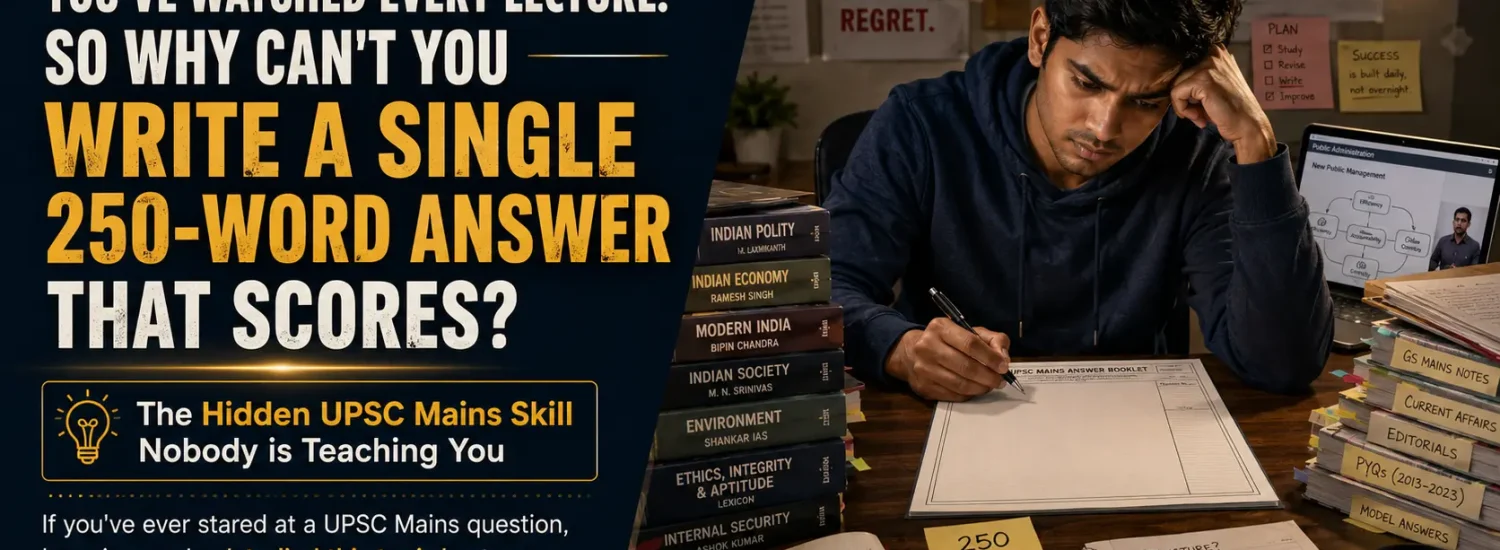
If you’ve ever stared at a UPSC Mains question, knowing you’ve “studied this topic,” yet your pen refuses to move — this article was written for you.
The Most Painful Moment in a UPSC Aspirant’s Life
It usually happens around 11:47 a.m. on a mock-test morning.
You’ve read Laxmikanth twice. You’ve finished three rounds of Spectrum. You’ve watched 400 hours of lectures. You have notebooks stacked like Jenga towers. You’ve highlighted, color-coded, mind-mapped, and Anki-flashcarded your way through the syllabus.
Then the question appears:
“Critically examine the role of the Inter-State Council in promoting cooperative federalism. (250 words)”
You know this. You know you know this.
But your hand freezes. Your mind starts loading 47 disconnected facts. You write three lines, scratch them out. You start with “In recent times…” — and immediately regret it. The clock keeps ticking. Eight minutes gone. Then twelve. You finally produce something that looks like a chewed sandwich of half-remembered article numbers, vague phrases like “challenges are many,” and a conclusion that sounds suspiciously like every other conclusion you’ve ever written.
And then you close the notebook and ask yourself the question that haunts every serious aspirant:
“Why can’t I write what I clearly know?”
Welcome to the real problem nobody is solving for you. It has a name.
The Real Diagnosis: It’s Not a Knowledge Problem. It’s “Conversion Anxiety.”
Here’s the brutal truth most coaching institutes won’t tell you, because their entire business model depends on selling you more content:
You don’t have a knowledge problem. You have a conversion problem.
You have collected raw materials like a hoarder. What you’re missing is the factory — the operating system that converts those materials into a finished product: a concise, structured, dimensioned, time-bound answer that an examiner can actually award marks to.
Read this comment from a real aspirant — one of thousands saying the same thing in different words:
“What if I don’t have one-pager notes and I am appearing in Mains 2025? How to make these one-pagers now and revise them 5–6 times?”
Or this one:
“How to write all the 10/12/15/20 points succinctly in 150 or 250 words?”
Or this one, which probably hurts the most:
“How to deal with questions that we don’t know?”
Notice something? None of these students are saying “I haven’t studied enough.” They’re saying: “I’ve studied. Now what?”
This is conversion anxiety. And it has six distinct layers. Let’s dissect each one — and then build the operating system that fixes it.
Layer 1: The Note-Making Trap (Or: Why Your 800-Page Notebook is Killing You)
There’s a quiet tragedy in every UPSC aspirant’s room: a beautifully maintained notebook that will never be revised even once before the exam.
Aspirants ask, over and over: “Sir, 1 pager notes kaise banaye?” “Crisp notes kaise banaye?” “How to make notes from a mains answer writing perspective?”
Here’s what’s actually happening: students are making reading notes when they should be making writing notes. These are completely different animals.
- Reading notes are organized like a textbook. They help you understand a topic.
- Writing notes are organized like an answer. They help you produce a topic.
A reading note on Cooperative Federalism might have ten paragraphs explaining the concept, its history, key institutions, court judgments, and so on.
A writing note on the same topic looks like this:
Cooperative Federalism — One-Pager Definition (1 line): Centre-State partnership for governance. Constitutional Anchors: Art 263 (ISC), 7th Schedule, GST Council (Art 279A). Institutional Tools: Inter-State Council, NITI Aayog, Zonal Councils, Finance Commission. 5 Strengths (1 phrase each): Policy harmonization, conflict resolution, fiscal devolution, COVID coordination, GST consensus model. 5 Weaknesses (1 phrase each): Centralizing tendencies, weak ISC, fiscal asymmetry, governor misuse, single-party dominance. Way Forward (3 actionable points): Empower ISC, judicial federalism, asymmetric devolution. Quotable Anchor: SR Bommai case, Punchhi Commission, Sarkaria recommendations.
That’s one page. That’s everything you need to write a 250-word answer on any dimension of cooperative federalism. It compresses 60 pages of Laxmikanth, 40 pages of newspaper notes, and 10 hours of class into a single dense page you can revise in 90 seconds.
Rule of thumb: If your “one-pager” can’t be revised in under two minutes, it isn’t a one-pager. It’s a shorter book.
Layer 2: The Question-Decoding Crisis (Or: Why You Always Write the “Wrong” Right Answer)
A student wrote: “I have problem of lack of diversification in my points… writing same sub points.” Another said: “Difficulty in identifying sub parts of History question.”
This is the second great UPSC tragedy: students answering a question the examiner didn’t ask.
Every UPSC question has four invisible parts:
- The Directive — what you’re being asked to do (examine, discuss, evaluate, comment).
- The Subject — what topic you’re being asked about.
- The Dimensions — the angles you must cover.
- The Hidden Sub-parts — the implicit questions inside the main question.
Take this real question: “Examine the implications of the ‘Right to be Forgotten’ for individual privacy and freedom of expression in India.”
A weak student reads this as: “Write about Right to be Forgotten.”
A strong student decodes it as:
- Directive: Examine (so I need balanced analysis, not just description).
- Subject: Right to be Forgotten.
- Dimensions: (a) privacy implications, (b) free speech implications.
- Hidden Sub-parts: Indian context specifically, constitutional anchoring (Puttaswamy), tension between Article 21 and Article 19(1)(a), recent cases, global comparison.
That decoding alone — done in 90 seconds with a pen on the question paper — guarantees a structured answer. The student who skips it ends up writing 250 words about what the Right to be Forgotten is, which is exactly what the examiner didn’t ask.
The 90-Second Decode Drill: Before you write a single word, underline the directive, circle the subject, list the dimensions in the margin, and force yourself to write at least two hidden sub-parts. If you can’t find sub-parts, you haven’t understood the question yet.
Layer 3: The Word-Limit War (Or: Why More Points Are Killing Your Marks)
Here’s a counterintuitive truth: most students lose marks not because they wrote too little, but because they tried to write too much.
A student lamented: “How to write all the 10/12/15/20 points succinctly in 150 or 250 words?”
The answer is simple and brutal: you don’t. You select 5 powerful points and develop them, instead of dumping 15 telegram-style headings.
Here’s the math examiners actually use (unofficially, but consistently observed):
- A 250-word answer = roughly 25 sentences = roughly 5 to 7 well-developed points.
- Each point should have: a claim + an explanation/example + a link back to the question.
The “Big 5” framework works like this for any 250-word answer:
- Intro (2 sentences): Definition + context anchor.
- Body Point 1: Claim — Example — Implication.
- Body Point 2: Same structure.
- Body Point 3: Same structure.
- Counter-perspective (1 point): A balancing dimension.
- Way Forward (2 sentences): Specific, not generic.
- Conclusion (2 sentences): Forward-looking, balanced.
That’s it. Five real points, framed properly, beats fifteen one-line headings every single time. Examiners reward depth per point, not points per page.
Layer 4: The “I Don’t Know This Question” Panic (And the Framework That Saves You)
Every aspirant’s worst nightmare: a question on something you’ve barely heard of. A student asked: “UNCTC question… only generic idea. How to tackle such questions?” Another: “What if the question is too specific?”
Here’s a secret toppers won’t put on Instagram: they don’t know every question either. They just have a fallback framework that makes “barely knew it” look like “fully prepared.”
It’s called the DRACO Framework (yes, like the constellation, easier to remember):
- D — Define / Context: Even a one-line definition or contextual anchor establishes credibility.
- R — Relevance: Why does this topic matter right now? Link to a current event, scheme, judgment, or trend.
- A — Analyse with Generic Dimensions: Every topic has six universal dimensions you can almost always invoke — political, economic, social, technological, legal/constitutional, environmental/ethical. Pick three that fit.
- C — Constitutional / Data / Example Anchor: Drop in one authoritative anchor — an Article, a Supreme Court case, a committee report, a data point, an international convention.
- O — Outlook / Way Forward: A specific, calibrated conclusion that suggests a direction.
For that “UNCTC” question — even if you’ve only “heard of” the UN Counter-Terrorism Committee — you can:
- Define it (1 line — UN body monitoring 1373 resolution post-9/11).
- Establish relevance (India’s chairmanship in 2022, Mumbai meeting).
- Analyse three dimensions (legal coordination, capacity-building, gaps in enforcement).
- Anchor (FATF link, India’s CCIT proposal pending since 1996).
- Way forward (broader consensus on definition of terrorism, no safe havens).
That’s a respectable 200-word answer built almost entirely from a framework, not from memorized content. Marks-worthy. Replicable. Calm under pressure.
Layer 5: The Language Wall (Especially for Hindi-Medium and Bilingual Students)
This is one of the most underdiscussed problems in the entire UPSC ecosystem. A student wrote, heartbreakingly:
“Find myself difficult while writing the answer… not good neither in English nor in Hindi.”
And another:
“Hindi medium mein answer writing nahi hai… mera medium Hindi hai to main kya karoon?”
If you’re a Hindi-medium aspirant, an English-transition student, or someone genuinely bilingual: answer writing is harder for you not because you know less, but because expression takes more cognitive load. That’s a real, measurable disadvantage — and it has real, structural fixes.
The Bilingual Aspirant’s Toolkit:
- Build a “Connector Bank” in your chosen language: 30 phrases for intro (“Article 21 of the Constitution recognises…”), 30 for transitions (“However, this view overlooks…”), 30 for conclusion (“A calibrated path forward involves…”). Memorize them like multiplication tables. They become your scaffolding on exam day.
- Use a “Skeleton-First” Method: Write the answer’s bones in bullet form in your strongest language. Then write the actual answer in your exam medium. This separates thinking from expressing.
- One Language. Pick Hard. Bilingual switching mid-prep is the number one productivity killer. Choose your medium by August before mains and refuse to switch.
- Read editorials in your medium. Hindi-medium students should read Jansatta and Hindustan‘s editorial pages alongside English ones. Vocabulary builds by exposure, not memorization.
Language is not your ceiling. It’s just your current scaffolding. Replace it brick by brick.
Layer 6: The Feedback Void (Or: Why Studying Alone Makes You Worse)
A student asked, almost wistfully: “Is this batch for daily answer writing where we will get evaluation from?”
Here’s something most aspirants don’t realize: answer writing without feedback is just calligraphy. You’re not improving. You’re just practising your bad habits more efficiently.
You need three feedback loops, in increasing order of value:
- Self-review (Daily): After writing, wait 30 minutes. Then read your own answer like an examiner. Mark: Did I address the directive? Did I cover all sub-parts? Did I stay within word limit? Did I use one anchor per point?
- Peer review (Weekly): Swap answers with one serious aspirant. Force them to give you one specific criticism, not generic praise.
- Mentor review (Bi-weekly): Even one evaluated copy a fortnight from someone who has actually scored well — or actually taught Mains — is worth more than 50 unreviewed answers.
The aspirant who writes 100 answers and reviews zero will lose to the aspirant who writes 30 and reviews each one twice.
The Mains Answer Writing Operating System: Putting It All Together
So what does the complete OS look like? Here’s the blueprint:
Phase 1 — Pre-Writing (Done over months, not days):
- Build one-pager writing notes for every GS-1 to GS-4 sub-topic.
- Maintain a separate “current anchors” sheet — schemes, judgments, reports, data — updated monthly.
- Build your connector bank in your exam medium.
Phase 2 — Question Encounter (90 seconds before you start writing):
- Underline the directive.
- Circle the subject.
- List dimensions in the margin.
- Identify two hidden sub-parts.
- Pick five points. Number them. Now write.
Phase 3 — Writing (8 to 12 minutes per answer):
- Open with definition + context (2 sentences).
- Develop 5 points: Claim → Example/Anchor → Implication.
- Include one balancing perspective.
- Close with a specific, forward-looking conclusion.
Phase 4 — Post-Writing (As important as the writing itself):
- Self-review within 30 minutes.
- Track recurring mistakes in a “Mistake Diary.”
- Send for evaluation at least twice a month.
Phase 5 — Iteration (Where the magic happens):
- Rewrite your worst answer of the week using the same question, after seeing where you went wrong.
- This single habit improves you faster than reading three new books.
The Final Wake-Up Call
There’s a comment in the feedback that captures the despair of an entire generation of aspirants:
“No one knows what works or what doesn’t. All you can do is pray it works.”
That’s not true. That’s just what it feels like when you’ve been told to study harder when the actual problem is that nobody taught you how to write.
UPSC Mains is not a memory test. It’s a conversion test. It rewards the aspirant who can take twelve months of preparation and compress it, on demand, into a 250-word product that is structured, balanced, anchored, and finished within eight minutes.
That skill doesn’t come from reading another book. It comes from building the operating system.
Stop hoarding content. Start practising conversion. Make your notes shorter, your decoding sharper, your points fewer, your anchors stronger, your conclusions more specific, and your feedback loops tighter.
The aspirant who masters the OS doesn’t pray it works. They know it does — because they can prove it, one 250-word answer at a time.
Your books are ready. Your knowledge is ready. The only thing left to build is the factory that turns it into marks.
Now go write your next answer. And this time, time yourself.