
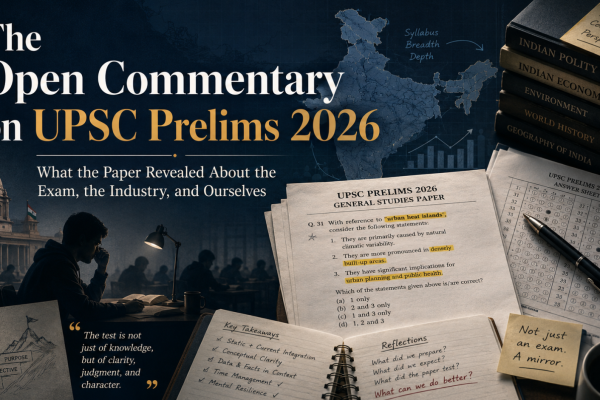
UPSC Prelims 2026 was conducted on Sunday, 24 May 2026 first half, marking the start of the most important examination cycle on the Civil Services calendar. For the lakhs of aspirants who walked out of examination halls earlier today, the next forty-eight to seventy-two hours are about cross-checking attempts against a reliable copy of the question paper and arriving at a defensible score estimate
Below, you will find the verified route for the UPSC Paper 1 download, the timeline for the provisional answer key, and a structured roadmap of the analysis sections being prepared. The subject-wise distribution, the difficulty rating, the provisional answer key for UPSC Prelims 2026, the expected cutoff, and trend observations will go live in stages.
UPSC Prelims 2026 is not a milestone that matters only to candidates who wrote the exam today. It is, in equal measure, a key resource for aspirants preparing for the 2027 attempt, for mentors building next year’s curriculum, and for writers tracking the slow shifts in the Commission’s questioning style.
UPSC Exam Date 2026 and Key Paper Details
The upsc exam date 2026 for the Civil Services Preliminary Examination was 24 May 2026 (Sunday), as confirmed by the official UPSC Annual Calendar. Paper 1, the General Studies paper, was held in the forenoon shift from 9:30 AM to 11:30 AM, and Paper 2 (CSAT) was conducted in the afternoon shift the same day. The Mains stage for qualifiers of UPSC CSE Prelims 2026 begins on 21 August 2026.
| UPSC CSE 2026 | Details |
|---|---|
| UPSC Prelims Exam Date | 24 May 2026 |
| Provisional Answer Key Release | To be updated |
| Result Announcement | Available soon |
| Total Candidates Appeared | To be updated |
| Total Vacancies | 933 |
| Where to check Prelims result | To be updated |
| No. of Candidates Qualified Prelims 2026 | To be updated post result |
Each paper carries 200 marks across 100 objective questions, with two hours allotted per paper. A correct answer in Paper 1 earns 2 marks, and incorrect answers attract a penalty of one-third. Paper 1 marks determine qualification for Mains, while Paper 2 is qualifying and requires a 33 percent score. Knowing these specifics about the upsc exam date 2026 and the marking scheme is essential before any meaningful self-evaluation begins.
How to Complete the UPSC Paper 1 Download from the Official Source
Candidates looking for a verified UPSC Paper 1 download should rely on the official Union Public Service Commission portal at www.upsc.gov.in. The official PDF is the only version that can be cited with confidence during answer key debates, score calculation, and any formal representation.
you can alternatively Download the Question Paper 1 from here:
To complete the UPSC Paper 1 download, navigate to the Examinations tab on the upsc.gov.in homepage and open the Previous Question Papers section. Locate the link titled Civil Services (Preliminary) Examination 2026, open the General Studies Paper 1 entry, and download the PDF for each series.
The Commission usually uploads question papers within a few days to a few weeks of the examination. Until the official upload appears, aspirants can rely on memory-based question paper compilations prepared by independent review teams. These are typically accurate enough for preliminary score estimation, but the official version remains the gold standard for any final claim about UPSC Prelims 2026.
GS Paper 1 PDF Download: What to Expect After Exam Day
The GS Paper 1 PDF download will be available through two streams. The first is the official upload by the Commission on upsc.gov.in, which is the authoritative version. The second is a set of memory-based reconstructions released by independent review teams in the first twenty-four to forty-eight hours after the exam. Both streams have their place.
For the GS Paper 1 PDF download from the official site, the Commission publishes all four series — A, B, C, and D — together. Candidates should download the paper for the specific series they attempted and a second series for cross-reference, because question order varies across series even though the content is identical. The GS Paper 1 PDF download should be saved offline before the UPSC Prelims 2026 analysis exercise begins.
UPSC Prelims 2026 Difficulty Level Review
The UPSC Prelims 2026 GS Paper I (Test Booklet Series A, Code: TDMN-A-ASO) presented a moderate to difficult challenge for aspirants, consistent with the upward trend in complexity seen over the past few years. A close reading of all 100 questions reveals a paper that deliberately rewarded deep conceptual understanding over rote memorization, making it one of the more demanding editions in recent memory.
Statement-Based Questions Dominated the Paper
A defining feature of this paper was the overwhelming use of multi-statement MCQs — where candidates had to evaluate 2 to 4 statements and identify correct combinations. Questions from Q3 to Q100 were heavily loaded with this format. This structure significantly raised the difficulty because even partial knowledge could lead to an incorrect answer. Questions on topics like the Harappan civilization (Q8), Rigvedic period irrigation (Q10), India’s space programme (Q46), and National Quantum Mission (Q49) all demanded precise, statement-level accuracy.
History and Art & Culture: Unusually Specific
The Ancient History and Art & Culture section was arguably the most niche segment of the paper. Questions such as identifying the Carnatic equivalent of Raga Bilawal (Q1), the significance of the Hallisalasya painting in Bagh Caves (Q6), matching ancient river names like Vitasta, Asikni, and Parushni with their modern counterparts (Q13), and identifying the early Buddhist iconographic meaning of an empty seat (Q12) required a level of specificity that went well beyond standard NCERT preparation. Candidates relying solely on standard textbooks would have found this section particularly challenging.
Modern History Was Relatively Manageable
In contrast, Modern History questions (Q2, Q9, Q16, Q17, Q18) were more straightforward for well-prepared candidates. Questions on the Hilton-Young Commission (Q2), the Eka Movement vs. Bardoli Satyagraha (Q9), and the formation of the Forward Bloc (Q16) were within the expected preparation range, though the statement-based format still demanded precision.
Science & Technology: High Difficulty, Very Contemporary
The Science & Technology section (Q41–Q50, Q79, Q80, Q84) stood out as one of the toughest segments. Questions on Large Language Models (Q42), stealth technology (Q43), drone swarms (Q47), GenomeIndia Project (Q48), National Quantum Mission (Q49), and India’s Deep Ocean Mission (Q50) tested cutting-edge knowledge. Q79 on DHRUV64, India’s first homegrown 64-bit microprocessor, and Q84 on the Bharat Forecast System were highly current and would have stumped candidates without dedicated science & tech current affairs preparation.
Current Affairs and International Relations: Very High Demand
The International Relations and Current Affairs section (Q61–Q78, Q81) was dense and wide-ranging. Questions referenced the AI Impact Summit 2026 held in New Delhi (Q65), the German Chancellor’s visit to India in January 2026 (Q78), the 2025 Nobel Prize winner (Q81), and the UN Ocean Conference held in France in June 2025 (Q38). These questions tested very recent developments and rewarded candidates who followed monthly current affairs diligently.
Economy Section: Conceptual Yet Tricky
The Economy section (Q86–Q100) blended conceptual questions with current affairs. Questions on blockchain technology (Q86), UPI vs. Digital Rupee (Q90), Real-World Assets Tokenization (Q91), M1xchange for MSMEs (Q93), and Multidimensional Poverty Index (Q100) were conceptually sound but required updated knowledge. The question on the Crowding Out Effect (Q94) was a relatively easier economy question that tested basic fiscal policy understanding.
Ethics Scenario Questions: A Noteworthy Trend
Questions Q51, Q52, and Q53 introduced governance ethics scenarios — a format that is increasingly appearing in GS Paper I. These involved a senior officer managing a vaccination programme (Q51), tribal land conflict resolution (Q52), and a civil servant dealing with contractor integrity (Q53). These questions tested applied understanding of public administration principles rather than factual recall, adding a unique dimension to the paper.
Overall Verdict
| Difficulty Parameter | Assessment |
|---|---|
| Overall Difficulty | Moderate–Difficult |
| Easiest Section | Modern History, Basic Polity |
| Toughest Section | Science & Technology, Art & Culture |
| Current Affairs Demand | Very High (up to early 2026) |
| Conceptual vs. Factual Balance | 60% Factual, 40% Conceptual |
| Statement-Based Questions | ~70 out of 100 |
UPSC Prelims 2026 Question Distribution Across Subjects
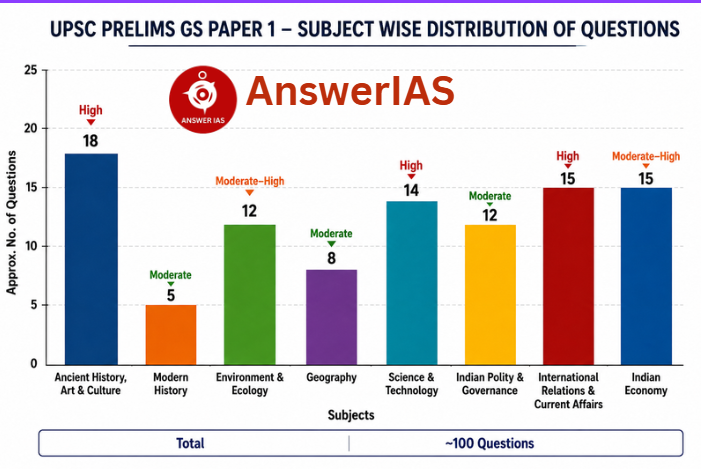
A subject-wise breakdown of the UPSC Prelims 2026 GS Paper I reveals a well-diversified paper that covered all major segments of the syllabus, with Environment & Ecology and Science & Technology receiving notably higher weightage than in previous years.
1. Ancient History, Medieval History & Art and Culture — ~18 Questions (Q1–Q20)
This was the largest single thematic bloc in the paper. Ancient History questions spanned the Harappan Civilization (Q8), the Rigvedic period (Q10, Q20), early coins and urban emergence (Q3), the place-value system (Q7), and river geography of the ancient period (Q11, Q13). Art & Culture questions covered Carnatic music (Q1), temple architecture with Nagara-style shikhara (Q4), Jain philosophy (Q5), the Bagh Caves painting (Q6), the Amaravati Stupa (Q14), early Tamilakam dynasties (Q15), and classical Hindustani music (Q19).
2. Modern History — ~5 Questions (Q2, Q9, Q16, Q17, Q18)
Modern History had a comparatively smaller but well-targeted presence. Key topics included the Hilton-Young Commission and rupee-sterling exchange (Q2), the Eka Movement and Bardoli Satyagraha (Q9), the formation of the Forward Bloc (Q16), British policy in Awadh post-1856 (Q17), and political community formation under the Montague-Chelmsford Reforms of 1919 (Q18).
3. Environment, Ecology & Geography — ~20 Questions (Q21–Q40)
This combined section was among the heaviest in the paper. Environment topics included India’s climate change response and LT-LEDS (Q21), Western Hoolock Gibbons (Q22), mangrove ecosystems (Q23), the Rainfed Area Development initiative (Q28), the Foxtail Orchid Rhynchostylis retusa (Q36), Moidams as a UNESCO World Heritage Site (Q37), UNOC 2025 Blue Transformation (Q38), Lake Turkana (Q39), and REDD+ projects in India (Q40). Geography questions addressed the Vizhinjam Seaport (Q24), the Brahmaputra river system (Q25), Indian state boundaries (Q26), the Strait of Hormuz (Q30), Peninsular Block features (Q34), the Sagarmala Programme (Q35), Andaman & Nicobar climate (Q33), and the Tungurahua Volcano UNESCO Global Geopark 2025 (Q31).
4. Science & Technology — ~14 Questions (Q41–Q50, Q79, Q80, Q83, Q84)
Science & Technology carried significant weight and was among the more difficult sections. Topics covered genetic medicine (Q41), Large Language Models in machine learning (Q42), stealth technology (Q43), aircraft Black Boxes (Q44), Green Hydrogen and the National Green Hydrogen Mission (Q45), private entities in India’s space programme including Agnikul Cosmos (Q46), drone swarm technology (Q47), the GenomeIndia Project (Q48), the National Quantum Mission (Q49), India’s Deep Ocean Mission and Matsya-6000 (Q50), DHRUV64 microprocessor (Q79), bomb disposal BIS standard IS 19445:2025 (Q80), semiconductor plant locations (Q83), and the Bharat Forecast System (Q84).
5. Indian Polity & Governance — ~12 Questions (Q51–Q60, Q62, Q63)
The Polity section was rich in both constitutional knowledge and applied governance. Topics included public administration ethics scenarios (Q51–Q53), the scope of ‘law’ under Article 13 (Q54), statements about the Constitution of India (Q55), the Rights of Persons with Disabilities Act and related bodies (Q56), SC/ST provisions in the Constitution (Q57), parliamentary questions — starred vs. unstarred (Q58), the Parliamentary Committee on Welfare of SC/ST (Q59), Mission Sudarshan Chakra (Q60), Zero FIR under BNSS 2023 (Q62), and Government organisations like CEIB, SFIO, and CBI (Q63).
6. International Relations & Current Affairs — ~15 Questions (Q61, Q64–Q78, Q81, Q82, Q85)
This section tested awareness of recent diplomatic, defence, and global events. Key topics included river bridges connecting India with neighbours (Q61), international conventions not ratified by India (Q64), the AI Impact Summit 2026 New Delhi (Q65), India-ASEAN connectivity projects (Q66), India-supported projects abroad (Q67), defence hardware manufactured in India (Q68), multilateral cooperation platforms (Q69), UN agencies awarded the Nobel Prize twice (Q70), UN Peacekeeping Operation timelines (Q71), BIMSTEC establishment locations (Q72), Indian Army Corps headquarters (Q73), Revamped RGSA (Q74), EU member countries (Q75), INTERPOL notice types (Q76), NIRANTAR platform (Q77), German Chancellor’s India visit 2026 (Q78), Nobel Prize 2025 (Q81), Grand Slam tennis (Q82), and the film Boong and BAFTA (Q85).
7. Indian Economy — ~15 Questions (Q86–Q100)
The Economy section concluded the paper with a strong focus on financial institutions, technology, and new-age economic concepts. Topics included blockchain technology features (Q86), the dropshipping e-commerce model (Q87), RBI’s Financial Inclusion Index (Q88), India’s ONDC initiative (Q89), UPI vs. Digital Rupee (Q90), Real-World Assets Tokenization (Q91), Sustainability Bonds (Q92), M1xchange and MSMEs (Q93), the Crowding Out Effect in fiscal policy (Q94), Rare Earth Elements and Critical Minerals (Q95), aviation sector insurance (Q96), crowdfunding (Q97), banking/finance committees in India (Q98), NBFCs in India (Q99), and the Multidimensional Poverty Index (Q100).
UPSC Prelims 2026 Provisional Answer Key — Release After Exam Day
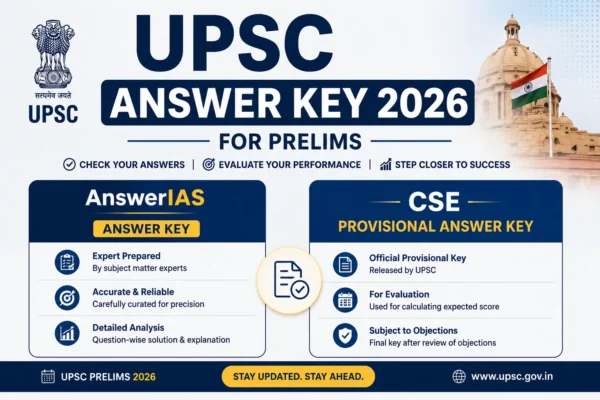
The UPSC Prelims 2026 provisional answer key will be added to this page in the hours and days that follow exam day, once the review team has cross-checked answers across multiple reliable sources. A provisional answer key, by definition, is released after exam day as a working reference for self-evaluation, and it is distinct from the official answer key that the Commission publishes much later.
The provisional answer key for UPSC Prelims 2026 will cover all four series of the paper — A, B, C, and D. Each question will carry a recommended answer with a brief explanation pointing to the source. Where two independent reviewers disagree, the question will be flagged as disputed. Every UPSC Prelims cycle produces between six and ten genuinely contentious questions, and those sometimes decide qualification at the margins of the cutoff.
It is also important to note when the official answer key arrives. The Commission releases its official answer keys only after the entire Civil Services Examination cycle, including Mains and the Personality Test, has concluded. That means the official answer key for UPSC Prelims 2026 is unlikely to appear before mid-2027. Until then, every score estimate generated from a provisional answer key is an informed approximation rather than a final figure.
How UPSC Prelims 2026 Supports Mains Preparation
UPSC Prelims 2026 carries value far beyond the qualification it offers for the Mains stage. A significant share of its questions reflects broader themes that reappear in Mains General Studies papers, in essay topics, and even in Personality Test discussions. Aspirants who clear UPSC CSE Prelims 2026 should treat the paper as a guide to the issues the Commission considers important in the current cycle.
A simple exercise is to read each question not as a multiple-choice problem but as a topic stub. A question on the regulatory framework of digital lending becomes a doorway to a Mains-level discussion of financial inclusion and the evolving mandate of the Reserve Bank of India. A question on a Ramsar site opens up the conversation around wetlands and the National Wetland Conservation Programme. Read this way, UPSC Prelims 2026 becomes one of the most current Mains preparation resources available.
A curated list of Mains linkages drawn directly from UPSC Prelims 2026 will follow, identifying the relevant Mains GS paper, the syllabus head, and the angle from which each issue can be developed. The first two weeks after Prelims are the most productive Mains preparation window in the calendar, and that window does not reopen.
What UPSC Prelims 2026 Teaches Aspirants Targeting 2027
For aspirants targeting the 2027 attempt, UPSC Prelims 2026 is the single most current data point on what the Commission expects. Older question papers remain useful for practice, but the 2026 paper reflects the most recent editorial choices, and a careful reading will reveal trends that older papers no longer can.
Three exercises are particularly useful. The first is to attempt UPSC Prelims 2026 under strict timed conditions before reading any analysis, so the candidate’s own attempt range is genuine. The second is to mark every question as solvable through NCERT and standard textbooks, solvable through current affairs of the last twelve months, or requiring something more specific. This three-bucket classification reveals where the marks really live. The third exercise is to study the wrong options, because UPSC’s distractors are themselves a hidden syllabus map of what the Commission considers adjacent and testable.
Used in this manner, UPSC Prelims 2026 becomes a calibration tool rather than a one-off mock test. The exercise is most rewarding after at least one complete revision of static subjects, when the candidate has the baseline knowledge to learn from the paper rather than be overwhelmed by it.
What to Expect in the Weeks After UPSC Prelims 2026
The next few weeks will follow a familiar rhythm. The Commission will upload the official PDF for the UPSC Paper 1 download to its website within a few days to a few weeks. Independent review teams will release consolidated provisional answer keys, which will be the primary basis for score estimation. The UPSC Prelims 2026 result is typically announced in mid-July, after which the Detailed Application Form for Mains opens, and the UPSC Mains 2026 examination begins on 21 August 2026.
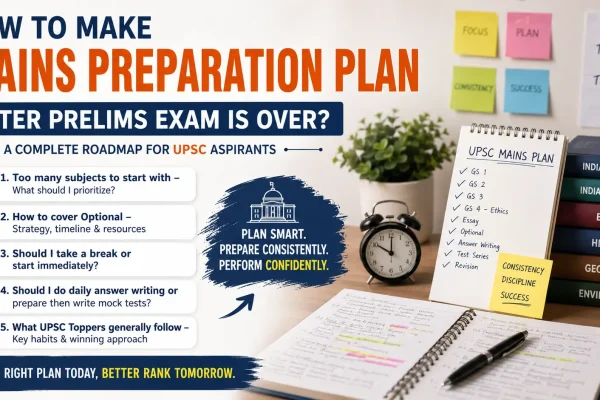
For candidates whose estimated scores comfortably exceed the expected cutoff, Mains preparation should begin without delay. Essay, the optional subject, and General Studies Paper 2 offer the highest return on the first two weeks of focused study. Candidates closer to the borderline should give themselves a week of rest, then begin Mains preparation on the assumption that they have qualified in UPSC CSE Prelims 2026. The cost of preparing and not qualifying is small; the cost of qualifying and being unprepared is substantial.
Aspirants are also encouraged to limit time spent in post-exam forums. The conversations there are emotionally charged, and the answer claims that circulate converge toward the loudest voices rather than the most accurate ones. Reading two or three carefully prepared analyses of UPSC Prelims 2026, including the one being built here, is more valuable than thirty competing hot takes.
Frequently Asked Questions on UPSC Prelims 2026
Q1. What is the UPSC exam timing for Prelims 2026?
The UPSC exam timing for Prelims 2026 follows the standard schedule set by the Union Public Service Commission. Paper I (General Studies) is conducted from 9:30 AM to 11:30 AM, and Paper II (CSAT) is held from 2:30 PM to 4:30 PM. Candidates appearing for the UPSC exam must report at the exam centre at least 30 minutes before the scheduled UPSC exam timing to complete document verification and other entry formalities. Being aware of the exact UPSC exam timing in advance helps candidates plan their travel and avoid last-minute stress on exam day.
Q2. When was the UPSC Prelims 2026 conducted and where can I find the official paper?
The UPSC Prelims 2026 was conducted as per the official calendar released on upsc.gov.in. The UPSC 2026 Prelims paper followed the traditional two-shift format on the scheduled exam date. The UPSC Prelims 2026 paper is now available for download on the official UPSC website as well as on major coaching platforms. Candidates who missed checking their responses on the day of the UPSC exam can refer to the UPSC 2026 Prelims paper to cross-verify their answers against the UPSC Prelims 2026 answer key released by various institutes. Staying updated through upsc.gov.in is the best way to access all official documents related to UPSC 2026.
Q3. Where can I download the UPSC Prelims 2026 question paper PDF?
The UPSC Prelims 2026 question paper PDF is available for free download on the official UPSC website immediately after the UPSC exam concludes. Reputed coaching institutes such as Vision IAS, Drishti IAS, and BYJU’S also upload the UPSC Prelims 2026 question paper PDF within a few hours of the exam, along with a detailed UPSC Prelims 2026 answer key for each set (A, B, C, D). Candidates should download the UPSC Prelims 2026 question paper PDF from trusted sources only to avoid errors in self-evaluation. The UPSC Prelims 2026 question paper is an essential resource for both this year’s result assessment and for aspirants preparing for future UPSC cycles.
Q4. How can I access the UPSC Prelims 2026 answer key?
The UPSC Prelims 2026 answer key is released in two stages — first, an unofficial answer key UPSC Prelims 2026 published by leading coaching institutes within hours of the UPSC exam, and later, the official UPSC answer key released by UPSC on its portal. Candidates can use the UPSC Prelims answer key 2026 to calculate their estimated score and assess their chances of clearing the Prelims 2026 cutoff. To access the UPSC 2026 answer key, visit upsc.gov.in or check the websites of reputed UPSC coaching platforms. The UPSC answer key is available for all test booklet series of the UPSC Prelims 2026 paper.
Q5. What is the pattern of the UPSC Prelims 2026 question paper?
The UPSC Prelims 2026 question paper consists of two papers. GS Paper I contains 100 MCQs carrying 200 marks, and CSAT Paper II contains 80 MCQs carrying 200 marks. The UPSC exam follows a strict negative marking rule, where one-third of marks are deducted for every wrong answer marked in the UPSC Prelims paper. Note that CSAT is qualifying in nature with a minimum requirement of 33% marks. Understanding the pattern of the UPSC Prelims 2026 paper is critical for both score calculation using the UPSC Prelims 2026 answer key and for future preparation strategies for UPSC 2026 Prelims.
Q6. What was the UPSC Prelims 2026 difficulty level?
The UPSC Prelims 2026 difficulty level was rated moderate to difficult by experts and toppers across leading coaching institutes. The UPSC Prelims 2026 paper had a heavy emphasis on statement-based MCQs, with approximately 70 out of 100 questions in this format, making the UPSC exam particularly demanding. The UPSC Prelims 2026 difficulty level was notably high in Science & Technology, Art & Culture, and Current Affairs sections. Topics such as LLMs, drone swarms, the National Quantum Mission, and the AI Impact Summit 2026 in the UPSC 2026 Prelims paper tested very current knowledge. Based on the overall UPSC Prelims 2026 difficulty level, experts predict a slightly lower cutoff compared to the previous year for Prelims 2026.
Q7. What subjects are covered in the UPSC Prelims 2026 paper?
The UPSC Prelims 2026 paper (GS Paper I) covered eight major subject areas — Ancient & Modern History, Art & Culture, Geography, Environment & Ecology, Indian Polity, Science & Technology, International Relations, and Indian Economy. The UPSC 2026 Prelims paper had approximately 18 questions from History and Art & Culture, 14 from Science & Technology, 15 from Economy, 15 from IR & Current Affairs, and 12 each from Polity and Environment. The UPSC Prelims CSAT Paper II tested reading comprehension, logical reasoning, and basic numeracy. Analysing the UPSC Prelims 2026 question paper subject-wise is one of the most effective strategies to refine preparation for the next UPSC exam.
Q8. How do I use the UPSC answer key to calculate my Prelims 2026 score?
To calculate your score using the UPSC answer key, first download the UPSC Prelims 2026 question paper PDF and the UPSC Prelims answer key 2026 for your specific test booklet series (A, B, C, or D). For every correct answer in the UPSC Prelims 2026 paper, add 2 marks, and for every wrong answer, deduct 0.66 marks (which is 1/3rd of 2). Questions left unattempted carry no penalty in the UPSC exam. Using the answer key UPSC Prelims 2026, you can arrive at your estimated raw score and compare it with previous years’ UPSC 2026 cutoffs to assess your chances. Most coaching institutes release a detailed UPSC Prelims 2026 answer key with explanations to help candidates understand difficult questions from the UPSC 2026 Prelims paper.
Q9. How many candidates appeared for UPSC Prelims 2026 and what is the expected cutoff?
Lakhs of aspirants registered for UPSC 2026, with approximately 5 to 6 lakh candidates appearing for the UPSC Prelims on exam day. Given the UPSC Prelims 2026 difficulty level being rated moderate to high, the expected Prelims 2026 cutoff for General category candidates is estimated to be in the range of 90–100 marks out of 200 by most coaching institutes. Only candidates who clear the Prelims 2026 cutoff will be called for the UPSC Mains examination. Candidates can verify their estimated score using the UPSC Prelims 2026 answer key and check against predicted cutoff trends for UPSC 2026 Prelims on reputed educational platforms.
Q10. What should I do immediately after the UPSC Prelims 2026 exam?
Right after the UPSC exam, candidates should download the UPSC Prelims 2026 question paper PDF and the UPSC Prelims answer key 2026 from reliable sources to calculate their estimated score. Match your responses against the answer key UPSC Prelims 2026 for each section of the UPSC Prelims 2026 paper. Based on your performance and the predicted Prelims 2026 cutoff, begin Mains preparation without waiting for official results. The official UPSC answer key and result for UPSC 2026 Prelims are typically declared 2–3 months after the UPSC exam timing date. Keep checking upsc.gov.in for the official UPSC 2026 answer key and further notifications related to UPSC 2026.

2 Comments