The UPSC Civil Services Prelims 2026 is over, and the only question on every aspirant’s mind is the same: what will the cut-off be? Instead of throwing out a number based on instinct, we analysed three years of official cut-off data alongside a question-by-question breakdown of the 2026 General Studies Paper 1. Here’s what the numbers actually say.
The Short Answer
The 2026 GS Paper 1 was noticeably harder than 2025. The number of genuinely difficult questions nearly doubled — from 14 in 2025 to 26 in 2026. On top of that, the “medium” questions came from unforgiving subjects like Current Affairs, Science & Technology, and Ancient History, rather than the more reasoning-friendly Environment and Polity. Because the paper was harder, fewer candidates will score high, and the cut-off is expected to drop slightly compared to 2025.
What Is a Cut-Off, and Why Does It Move Every Year?
Think of the cut-off as a pass mark that flexes with paper difficulty. The logic is simple:
If the paper is easy, scores rise across the board, and UPSC raises the cut-off to filter the right number of candidates. If the paper is hard, scores fall, and UPSC lowers the cut-off. Vacancy numbers also matter — more vacancies usually mean a slightly lower cut-off so more candidates qualify.
There’s also the negative marking effect. A wrong answer costs you 0.66 marks. When a paper is hard, smart candidates skip uncertain questions to protect their score, which keeps aggregate scores low and pulls the cut-off down with them.
What the Official Cut-Offs of 2023–2025 Tell Us
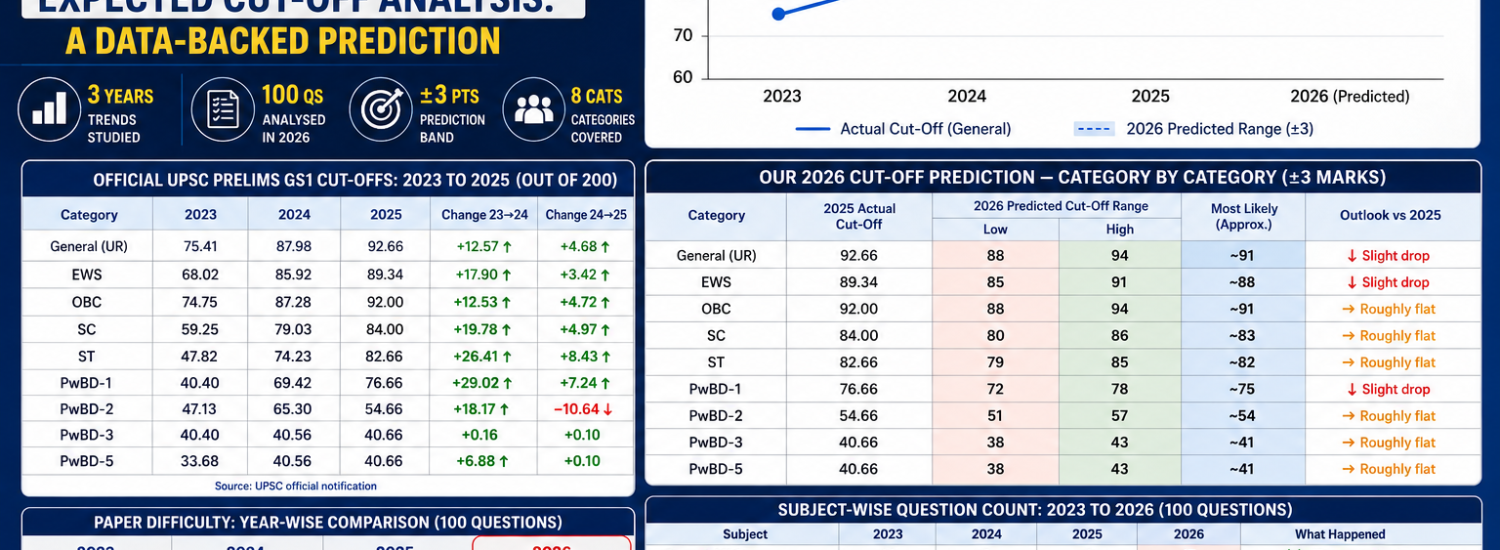
Here are the official UPSC GS Paper 1 cut-offs over the last three years (out of 200):
| Category | 2023 | 2024 | 2025 |
|---|---|---|---|
| General (UR) | 75.41 | 87.98 | 92.66 |
| EWS | 68.02 | 85.92 | 89.34 |
| OBC | 74.75 | 87.28 | 92.00 |
| SC | 59.25 | 79.03 | 84.00 |
| ST | 47.82 | 74.23 | 82.66 |
| PwBD-1 | 40.40 | 69.42 | 76.66 |
A few patterns stand out. 2023 was a brutally hard paper, which is why the General cut-off was just 75.41. 2024 saw a massive jump — cut-offs rose by 12 to 27 marks across categories because the paper turned much easier. 2025 climbed again, but only by about 4–5 marks for most categories. The deceleration is important — the cut-off curve was already flattening before 2026 even arrived.
How Hard Was Each Year’s Paper?
We tagged all 100 questions in each year’s paper by difficulty. The pattern is clear.
2023 had only 3 easy questions, 34 medium, 34 medium-hard, and 29 difficult. It was the hardest of the four years, and the General cut-off reflected that at 75.41.
2024 lightened up considerably — 13 easy, 47 medium, 20 medium-hard, and 20 difficult. The cut-off jumped to 87.98.
2025 was the easiest in this window — 14 easy, 56 medium, 16 medium-hard, and just 14 difficult. The cut-off peaked at 92.66.
2026 breaks the trend. Easy questions dropped to 11, medium questions rose to 63, medium-hard disappeared entirely, and difficult questions surged to 26 — almost double the previous year.
The headline number — 63 medium questions — might suggest the paper is manageable. But that hides the real story. Those medium questions came mostly from Current Affairs (17), Science & Technology (16), and Ancient History (10) — subjects where you either know the answer or you don’t. In 2024 and 2025, medium questions clustered in Geography, Environment, and Polity, where a prepared candidate could reason through unfamiliar territory. That option is gone this year.
The Subject Mix Has Shifted Sharply
UPSC changed the subject distribution significantly in 2026:
| Subject | 2023 | 2024 | 2025 | 2026 |
|---|---|---|---|---|
| Current Affairs | 14 | 8 | 4 | 17 |
| Science & Technology | 9 | 7 | 14 | 16 |
| Indian Economy | 19 | 17 | 16 | 17 |
| Indian Polity | 15 | 19 | 17 | 12 |
| Ancient History | 4 | 2 | 6 | 10 |
| Environment | 15 | 20 | 17 | 9 |
| Geography | 15 | 18 | 13 | 8 |
| Art & Culture | 3 | 5 | 4 | 6 |
| Modern History | 3 | 3 | 8 | 5 |
| Medieval History | 3 | 1 | 1 | 0 |
Current Affairs is the big story. After just 4 questions in 2025, it returned with a vengeance — 17 questions in 2026. Many aspirants who downgraded their newspaper reading after 2025 were caught flat-footed. Ancient History doubled from 6 to 10. Meanwhile, Environment fell from 17 to 9, and Geography hit its lowest point in four years with just 8 questions. These two subjects had been score-boosters; their reduced weight hurts almost every candidate.
Our 2026 Cut-Off Prediction
Based on the harder paper, the unexpected Current Affairs comeback, and the trajectory of the last three years, here are our predicted cut-off bands (±3 marks):
| Category | 2025 Actual | 2026 Low | 2026 Central | 2026 High | vs 2025 |
|---|---|---|---|---|---|
| General / UR | 92.66 | 89 | ~92 | 95 | Slight drop |
| EWS | 89.34 | 86 | ~89 | 92 | Slight drop |
| OBC | 92.00 | 89 | ~92 | 95 | Roughly flat |
| SC | 84.00 | 81 | ~84 | 87 | Roughly flat |
| ST | 82.66 | 80 | ~83 | 86 | Roughly flat |
| PwBD-1 | 76.66 | 73 | ~76 | 79 | Slight drop |
| PwBD-2 | 54.66 | 51 | ~54 | 58 | Some drop |
| PwBD-3 | 40.66 | 40 | ~42 | 44 | Roughly flat |
| PwBD-5 | 40.66 | 40 | ~42 | 44 | Roughly flat |
Why a Slight Drop and Not a Bigger One?
Four reasons drive this prediction.
First, the doubling of difficult questions from 14 to 26 means more candidates will skip rather than attempt, which lowers aggregate scores and pulls the cut-off down. Second, the “medium” questions this year are deceptive — they sit in subjects like Current Affairs and Ancient History where reasoning doesn’t help. Third, Current Affairs returning to 17 questions after two quiet years caught a lot of aspirants off guard, especially those who had de-prioritised it. Fourth, the cut-off rise was already slowing — from +12.57 in 2023–24 to just +4.68 in 2024–25. With a harder paper, the curve should bend downward rather than continue climbing.
The drop won’t be dramatic. We’re talking about a 1 to 3 mark adjustment, not a return to 2023 territory.
What This Means If You Just Wrote the Exam
If you’re in the General category and scored between 89 and 95, you’re in a realistic qualifying range, with about 92 as the central estimate. OBC candidates in the same band are similarly placed. SC candidates between 81 and 87 have a strong chance, with 84 as the central estimate. ST candidates between 80 and 86 are in the safe zone.
If you scored 2 to 3 marks below these bands, don’t panic — the ±3 uncertainty is real, and the official cut-off could land anywhere within it. More importantly, don’t stop preparing. Mains prep continues regardless of how prelims went. Time spent refreshing answer key websites is time you’ll regret later.
Risk Analysis for this Prediction
A few wild cards remain. If UPSC announces a significant increase in vacancies, the cut-off could come down further. If any questions are cancelled or awarded full marks — which has happened in previous years — aggregate scores rise and the cut-off pushes up by 1–2 marks. PwBD-2 is historically unpredictable; it dropped 10 marks in 2025 without an obvious explanation, so the band there carries more uncertainty than the others.
The official UPSC announcement remains the final word. Until then, this is your best evidence-based estimate — built on three years of cut-off data and a question-level breakdown of the 2026 paper, not guesswork.