The Union Public Service Commission (UPSC) has made history with a landmark reform for the Civil Services (Preliminary) Examination 2026. For the very first time, UPSC will release a Provisional Answer Key for UPSC Prelims 2026 soon after the conduct of the exam — a move celebrated as a major step toward greater transparency and candidate empowerment.
UPSC Chairman, Dr. Ajay Kumar, has officially termed this early release of the provisional answer key a “New Beginning” — marking the Commission’s most significant transparency reform in recent history.
AnswerIAS : UPSC Answer Key
ENVIRONMENT (16 Questions)
Q1 — India’s Long-Term Low Emission Development Strategy and climate change response — Ans: B
Q2 — Western Hoolock Gibbons — Ans: B
Q3 — Rationale for protecting mangrove ecosystems in climate resilience — Ans: D
Q7 — Arrival of Amur Falcons at Doyang Lake, Nagaland from Mongolia — Ans: A
Q8 — Objectives of Rainfed Area Development (RAD) under National Mission for Sustainable Agriculture — Ans: D
Q12 — Madhav National Park — Ans: B
Q16 — Rhynchostylis retusa (Foxtail orchid) — Ans: B
Q18 — UN Ocean Conference (UNOC), June 2025, France — FAO announcement — Ans: B
Q20 — First Plan Vivo certified REDD+ project in India — Ans: C
Q67 — NIRANTAR (National Institute for Research and Application of Natural Resources to Transform Rural Areas) — Ans: B
Q85 — Rare Earth Elements (REEs) and Critical Minerals — Ans: A
Q95 — Green Hydrogen — Ans: B
GEOGRAPHY (13 Questions)
Q5 — Identify river of Indian subcontinent (antecedent drainage) — Ans: C
Q6 — Indian States boundary sharing — Ans: C
Q10 — Countries crossing Strait of Hormuz to reach Indian Ocean — Ans: B
Q11 — Tungurahua Volcano declared UNESCO Global Geopark in 2025 — Ans: A
Q13 — Climate of Andaman and Nicobar Islands — Ans: B
Q14 — Geographical features of Peninsular Block of India — Ans: B
Q19 — Lake Turkana — Ans: B
Q31 — Pleistocene period Yamuna-Indus / Sutlej-Yamuna assertion — Ans: D
Q33 — Ancient and modern names of rivers (Vitasta, Asikni, Parusni) — Ans: C
Q51 — River bridges connecting India with neighbouring countries — Ans: D
HISTORY (15 Questions)
Q22 — Hilton-Young Commission (1926) rupee-sterling exchange rate — Ans: A
Q23 — Pali texts and references to coins — Ans: C
Q25 — Four main forms of existence in Jainism — Ans: B
Q27 — Place-value system usage in India (epigraphic) — Ans: D
Q28 — Archaeological findings in Harappan towns — Ans: A
Q29 — Eka Movement and Bardoli Satyagraha — Ans: C
Q30 — Rigvedic period — Ans: C
Q35 — Kings and dynasties of early historical Tamilakam — Ans: B
Q36 — Formation of Forward Bloc by Subhas Chandra Bose in 1939 — Ans: B
Q37 — British policy in Awadh after annexation in 1856 — Ans: A
Q38 — Political alliances based on community and Montague-Chelmsford Reforms — Ans: D
Q40 — Term kshetra-patni (‘mistress of the field’) origin — Ans: B
ART & CULTURE (9 Questions)
Q17 — Moidams built by Tai-Ahom kingdom, UNESCO World Heritage Site — Ans: C
Q21 — Carnatic music raga similar to Raga Bilawal in Hindustani music — Ans: D
Q24 — Temples with Nagara-style shikhara — Ans: B
Q26 — Hallisalasya painting in Bagh Caves — Ans: A
Q32 — Empty seat in early Buddhist iconography — Ans: A
Q34 — Amaravati Stupa and its relief sculpture — Ans: B
Q39 — Pandit Mallikarjun Mansur, classical singer from Karnataka — Ans: D
POLITY (18 Questions)
Q41 — Senior officer overseeing vaccination programme, ethical scenario — Ans: C
Q42 — Multi-ethnic district, community tensions flashpoint scenario — Ans: A
Q44 — Meaning of ‘law’ under Article 13, Part III of Constitution — Ans: D
Q45 — Statements about Constitution of India — Ans: B
Q46 — Persons with Disabilities in India — Ans: B
Q47 — Scheduled Castes and Scheduled Tribes provisions — Ans: A
Q48 — Questions asked by Members in Parliament of India (Starred/Unstarred) — Ans: C
Q49 — Committee on Welfare of Scheduled Castes and Scheduled Tribes, Parliament — Ans: D
Q52 — Zero First Information Report (Zero FIR) under BNSS 2023 — Ans: D
Q53 — Organisations under Government of India — Ans: A
Q54 — International conventions not ratified by India — Ans: D
Q60 — UN organisations/agencies — Ans: A
Q61 — UN Peacekeeping Operations (UNMIL, MINURCA etc.) — Ans: B
Q64 — Revamped Rashtriya Gram Swaraj Abhiyan (RGSA) — Ans: B
Q65 — Member countries of the European Union — Ans: C
ECONOMY (14 Questions)
Q4 — Vizhinjam International Seaport and India’s maritime trade policy — Ans: D
Q15 — Sagarmala Programme of Government of India — Ans: B
Q77 — E-commerce revenue model (dropshipping) — Ans: A
Q78 — Sub-indices of Financial Inclusion Index (FI-Index) of RBI — Ans: C
Q79 — Open Network for Digital Commerce (ONDC) initiative — Ans: C
Q80 — UPI and Central Bank Digital Currency (Digital Rupee) — Ans: D
Q81 — Real-World Assets (RWA) Tokenization — Ans: A
Q82 — Bond financing combination of environmental and social projects — Ans: C
Q83 — M1xchange’s role in MSME financing — Ans: B
Q84 — Crowding Out Effect in fiscal policy — Ans: B
Q86 — Insurance in aviation sector — Ans: C
Q87 — Crowdfunding — Ans: C
Q88 — Committees in India — Ans: D
Q89 — Non-Banking Financial Companies (NBFCs) in India — Ans: A
Q90 — Multidimensional Poverty Index (MPI) — Ans: A
SCIENCE & TECHNOLOGY (14 Questions)
Q58 — Defence hardware manufactured in India — Ans: A
Q69 — DHRUV64 chip — Ans: C
Q71 — Nobel Prize 2025 (UK-born, American university professor) — Ans: C
Q73 — Semiconductor plants in India and their locations — Ans: C
Q74 — Bharat Forecast System (indigenous high resolution weather model) — Ans: A
Q76 — Features of blockchain technology — Ans: C
Q91 — Genetic medicine — Ans: C
Q92 — Large Language Models (LLMs) in machine learning — Ans: B
Q93 — Stealth technology — Ans: C
Q94 — Black Boxes in modern aircraft — Ans: B
Q96 — Private entities in India’s space programme — Ans: A
Q97 — Drone swarms — Ans: B
Q98 — GenomeIndia Project — Ans: B
Q99 — National Quantum Mission (NQM) — Ans: C
Q100 — India’s Deep Ocean Mission — Ans: B
CURRENT AFFAIRS (10 Questions)
Q9 — Oeko-Tex certification for Eri Silk in global textile industry — Ans: C
Q50 — Mission Sudarshan Chakra — Ans: A
Q55 — AI Impact Summit 2026, New Delhi — Ans: D
Q56 — Connectivity projects between India and ASEAN — Ans: A
Q57 — Projects supported by India (Mangdechhu Hydroelectric Project etc.) — Ans: B
Q59 — Platforms for multilateral co-operation (Colombo Process etc.) — Ans: C
Q62 — BIMSTEC Centres/Establishments — Ans: C
Q66 — INTERPOL Notices (Silver, Blue etc.) — Ans: C
Q68 — Chancellor of Germany’s visit to India, January 2026 — Ans: B
Q75 — Film ‘Boong’ — Ans: A
OTHER (3 Questions)
Q43 — Mid-level civil service official, urban development, ethical scenario — Ans: B
Q63 — Indian Army Corps and their Headquarters — Ans: D
Q72 — Grand Slam Tennis Tournaments — Ans: C
UPSC 2026 Prelims – Quick Exam Details
| Detail | Information |
|---|---|
| Conducting Body | Union Public Service Commission (UPSC) |
| Exam Name | Civil Services (Preliminary) Examination 2026 |
| Papers | GS Paper I & GS Paper II (CSAT) |
| UPSC Exam Timing | 2 Hours per Paper |
| Answer Key Type | Provisional (Released after exam) |
| Representation Deadline | May 31, 2026 – 6:00 PM |
| Official Portal | upsconline.nic.in |
What Is the UPSC Prelims 2026 Provisional Answer Key?
The UPSC Prelims 2026 answer key is an official document published by the Commission containing the correct answers to all questions in the UPSC 2026 Prelims paper. Previously, UPSC released a final answer key only after a considerable delay — forcing candidates to depend on coaching institutes and unofficial sources.
This year’s reform changes everything. With the official UPSC answer key 2026 released soon after the exam, candidates can:
- Accurately estimate their score in the UPSC 2026 Prelims
- Make an informed decision about Mains preparation
- Submit objections if they believe any answer in the UPSC Prelims 2026 question paper is incorrect
- Plan ahead without waiting months for results
How to Download the UPSC Prelims 2026 Question Paper PDF
Candidates looking for the UPSC Prelims 2026 question paper PDF should download it directly from the official UPSC website to avoid misinformation from unofficial sources.
Download UPSC CSAT GS Paper 2 , 2026
Steps to access the UPSC 2026 Prelims question paper and answer key:
- Visit the official UPSC portal: https://upsconline.nic.in/login
- Log in using your registered UPSC credentials
- Navigate to the Civil Services Preliminary Examination 2026 section
- Download the UPSC Prelims 2026 question paper PDF for both GS Paper I and GS Paper II
- Cross-check your answers with the UPSC Prelims 2026 answer key
Important: Always rely on the official UPSC portal for the answer key upsc prelims 2026. Third-party answer keys may contain errors.
How to Submit Objections Against the UPSC 2026 Answer Key
A defining feature of this reform is the Online Question Paper Representation Portal (QPRep). If you believe any answer in the official UPSC Prelims answer key 2026 is incorrect, here is how to raise an objection:
Step 1: Log in to upsconline.nic.in using your registered UPSC credentials.
Step 2: Access the dedicated QPRep (Question Paper Representation) portal from your dashboard.
Step 3: Select the specific question(s) from the UPSC 2026 Prelims paper that you wish to challenge.
Step 4: Indicate the correct answer as per your understanding and provide a brief written justification.
Step 5: Upload supporting documents from at least three authentic sources — such as NCERT textbooks, official government reports, peer-reviewed journals, or other credible references.
Step 6: Submit your representation before the deadline — May 31, 2026, 6:00 PM.
All representations received will be placed before a team of subject-matter experts who will carefully examine each objection, assess the supporting documents, and record their considered opinion before the final UPSC 2026 answer key is published.
Why This Reform Is a Game-Changer for UPSC Aspirants
“For the first time, the Union Public Service Commission will release the Provisional Answer Key for the Civil Services Examination. This initiative reflects the Commission’s ongoing endeavour to bring greater transparency, responsiveness, and timely communication with candidates. The policy aims to make the examination process more participative while upholding its sanctity, integrity, and merit-based framework.” — Dr. Ajay Kumar, UPSC Chairman (PIB Delhi, May 18, 2026)
For years, aspirants preparing for the UPSC prelims had to wait months before any official answer key was released. In the absence of an official UPSC answer key, coaching institutes published their own versions — often contradicting each other and creating unnecessary confusion over cut-off estimates.
The introduction of the answer key UPSC Prelims 2026 immediately after the exam addresses this long-standing demand and delivers three powerful benefits:
1. Early Performance Assessment Candidates no longer need to guess their score. The official UPSC prelims 2026 answer key allows them to calculate their expected marks right away and plan their next steps with confidence.
2. Participative Examination Process Through the QPRep portal, candidates can directly engage with the examination process. This makes the UPSC 2026 prelims more democratic and merit-driven.
3. Greater Confidence in the System By publishing the provisional answer key and inviting expert review of all objections, the Commission is strengthening public trust in the UPSC exam process.
UPSC Prelims 2026 Difficulty Level – What Candidates Can Expect
The UPSC Prelims 2026 difficulty level will be fully analyzed by subject experts and coaching institutes once the UPSC Prelims 2026 question paper is publicly available.
Historically, the UPSC prelims General Studies Paper I covers:
- Modern and Ancient Indian History
- Indian and World Geography
- Indian Polity and Governance
- Indian Economy and Development
- Environment and Ecology
- General Science
- Current Affairs (National and International)
GS Paper II (CSAT) tests Comprehension, Logical Reasoning, Analytical Ability, Decision Making, Basic Numeracy, and Data Interpretation.
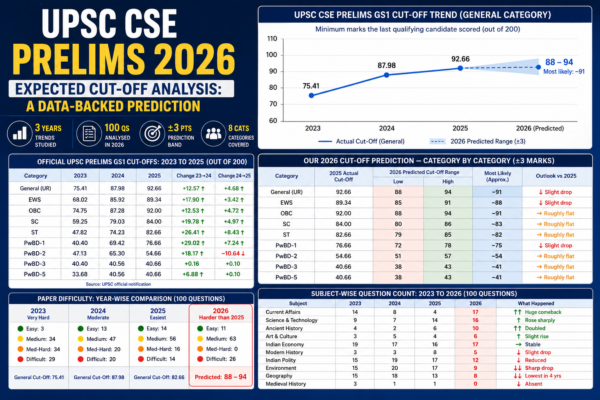
With the UPSC prelims 2026 answer key available shortly after the exam, analysts and candidates will have a clearer picture of the difficulty level and can estimate the expected UPSC 2026 Prelims cut-off more accurately.
UPSC Prelims 2026 Question Paper – Marking Scheme
Understanding the marking scheme of the UPSC 2026 Prelims paper is essential for calculating your score from the answer key:
| Paper | No. of Questions | Max Marks | Negative Marking |
|---|---|---|---|
| GS Paper I | 100 | 200 | 0.66 marks per wrong answer |
| GS Paper II (CSAT) | 80 | 200 | 0.83 marks per wrong answer |
| CSAT Qualifying Marks | — | 33% (66 marks) | — |
Use the official UPSC Prelims 2026 answer key to count your correct and incorrect responses and calculate your net score accordingly.
Important Dates – UPSC Prelims 2026 Answer Key
| Event | Date |
|---|---|
| UPSC Prelims 2026 Exam | 2026 |
| Provisional Answer Key Release | Soon after exam conduct |
| Representation Window Opens | Immediately after key release |
| Last Date to Submit Representations | May 31, 2026 – 6:00 PM |
| Final Answer Key Publication | After expert review of all objections |
Frequently Asked Questions (FAQs)
Q1. Where can I find the UPSC Prelims 2026 answer key? The official UPSC Prelims 2026 answer key will be available at upsconline.nic.in. Log in with your registered credentials to access it.
Q2. Can I challenge any answer in the UPSC 2026 answer key? Yes. Through the QPRep portal, candidates can submit objections to any answer in the UPSC prelims 2026 paper before May 31, 2026 at 6 PM.
Q3. What documents do I need to submit a representation? You must provide a brief justification and supporting material from three authentic sources such as NCERT books, official government publications, or verified journals.
Q4. What is the UPSC exam timing for Prelims 2026? Each paper of the UPSC exam is 2 hours long. GS Paper I is held in the morning session and GS Paper II (CSAT) in the afternoon session.
Q5. Is the provisional answer key the final one? No. The provisional UPSC answer key is subject to revision based on expert review of candidate representations. The final UPSC 2026 answer key is published only after all objections are thoroughly examined.
Q6. What is the difficulty level of UPSC Prelims 2026? The UPSC Prelims 2026 difficulty level will be assessed by experts once the full UPSC 2026 Prelims paper is analysed. Stay tuned for a detailed subject-wise analysis.
Conclusion
The release of the UPSC Prelims 2026 answer key immediately after the exam marks a new era for India’s most prestigious competitive examination. By introducing the provisional answer key and the QPRep representation portal, the Commission has made the UPSC 2026 prelims process more transparent, participative, and candidate-friendly than ever before.
Whether you are looking for the UPSC Prelims 2026 question paper PDF, want to check the answer key UPSC Prelims 2026, or plan to submit a representation — everything is now available through the official UPSC portal.