
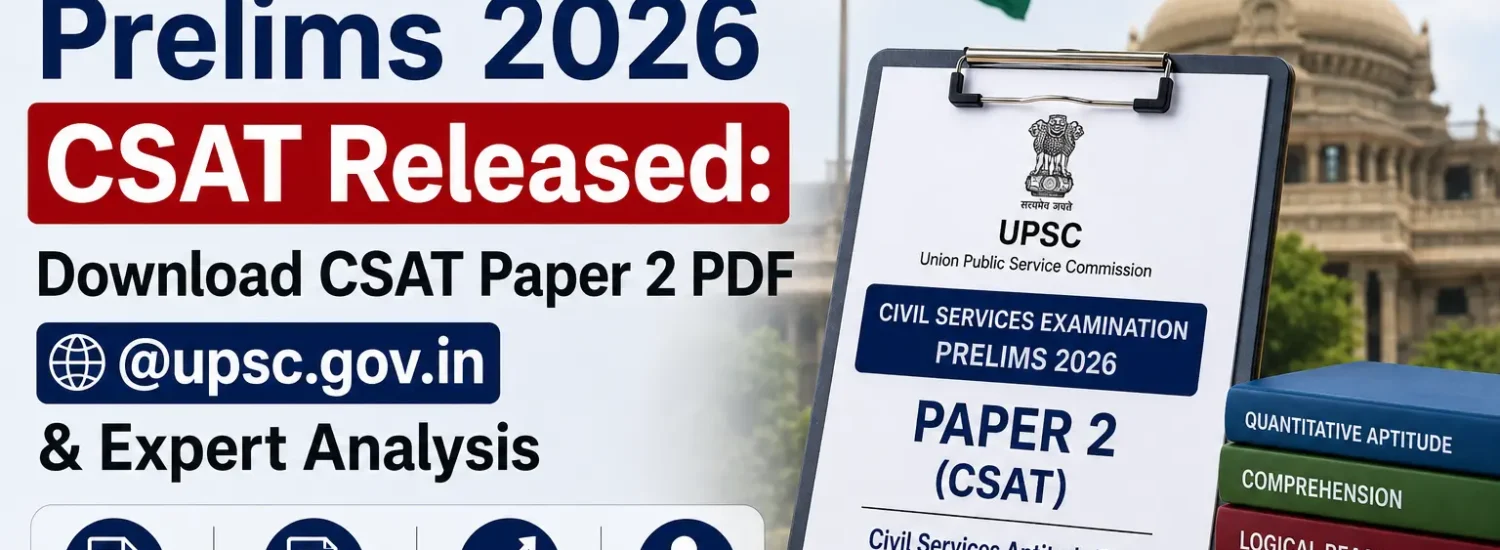
The UPSC Prelims 2026 CSAT paper has been conducted and the question paper is now available for download. With General Studies Paper 1 wrapped up in the morning and the aptitude paper finishing in the afternoon shift on 24 May 2026, the most demanding day on every aspirant’s calendar is finally over. For lakhs of candidates, the next forty-eight hours are about cross-checking attempts and arriving at a defensible estimate of the CSAT score — not because it counts toward Prelims merit, but because falling short of the qualifying mark would mean the entire General Studies effort goes to waste.
This page is a single, evolving destination for everything that follows the UPSC Prelims 2026 CSAT release: the verified download route from upsc.gov.in, an early commentary on the paper, a structured roadmap of the expert analysis being prepared, and a clearly-flagged section reserved for the provisional answer key that will be added after exam day. Bookmark it and return as each update goes live.
A note on why this matters more than the qualifying label suggests. The UPSC Prelims 2026 CSAT cycle inherits the legacy of recent years, in which the Commission has repeatedly shown that even a paper meant only to test aptitude can decide outcomes at the margins. A small number of candidates miss qualification each year not on the strength of their GS paper but on a poor CSAT showing. The expert analysis on this page is written with that practical concern in mind.
UPSC Prelims 2026 CSAT Paper Pattern and Marking Scheme
The UPSC Prelims 2026 CSAT, also known as Paper 2 of the Civil Services Preliminary Examination, was conducted in the afternoon shift on 24 May 2026, immediately following the General Studies paper from the morning. The paper carries 200 marks across 80 objective questions, with a duration of two hours. Each correct answer earns 2.5 marks, and each incorrect answer attracts a penalty of one-third. Decision-making questions traditionally carry no negative marking, though their exact count varies by year.
CSAT is qualifying in nature. To clear the UPSC Prelims 2026 CSAT, a candidate must score at least 33 percent — 66.66 marks on the 200-mark scale — irrespective of their performance in General Studies. Failure to meet this qualifying mark renders the candidate ineligible for Mains, regardless of how strong the GS Paper 1 attempt was. This single rule is why CSAT can never be treated as the easy second half of the day.
The paper is structured across three broad areas: comprehension and reading-based questions, logical reasoning and analytical ability with a decision-making sub-section, and basic numeracy and data interpretation. The exact share of each area shifts year to year, and the CSAT question distribution for 2026 is one of the most closely-watched outputs of the post-exam analysis cycle.
How to Download the UPSC Prelims 2026 CSAT Paper from upsc.gov.in
The verified path for the UPSC Prelims 2026 CSAT paper download begins at the official Union Public Service Commission portal, upsc.gov.in. The official PDF is the only version that can be cited with confidence during answer-key debates, score calculation, and any representation to the Commission.
To download the paper from upsc.gov.in, navigate to the Examinations tab on the homepage and open the Previous Question Papers section. Locate the link titled Civil Services (Preliminary) Examination 2026, open the General Studies Paper 2 (CSAT) entry, and download the PDF for each series. The Commission typically uploads all four series — A, B, C, and D — together. Save the file offline before the analysis exercise begins.
The Commission generally uploads question papers within a few days to a few weeks of the examination. Until the official PDF appears on upsc.gov.in, aspirants can rely on memory-based compilations of the UPSC Prelims 2026 CSAT paper prepared by independent review teams. These are typically accurate enough for preliminary score estimation, but the official version remains the standard for any final claim.
A note on the General Studies morning paper. Candidates and 2027 aspirants who landed on this page looking for the GS Paper 1 PDF download will find a separate, fully maintained companion article dedicated to that session. This page focuses exclusively on the UPSC Prelims 2026 CSAT and the expert analysis being prepared for it.
UPSC Prelims 2026 CSAT Difficulty Level Review (Section Updating)
The difficulty level of the UPSC Prelims 2026 CSAT will be assessed here over the next twenty-four to forty-eight hours, after the review team has worked through every question, cross-checked answers, and benchmarked the paper against previous years. A serious difficulty rating cannot be published in the first hours after an exam.
When the rating goes live, the paper will be assessed along three axes. The first is reading load — the total volume of comprehension passages and the density of unfamiliar vocabulary or abstract argumentation in them. The second is quantitative difficulty, which measures how many questions required multi-step calculation under time pressure and how many were solvable through estimation and elimination. The third is decision-making subtlety, which captures whether the situational-judgement questions admitted clean answers or asked candidates to choose between two near-equivalent options.
The benchmarking against earlier papers will be especially important this year. The 2023 CSAT paper is now part of UPSC lore — a paper widely regarded as the toughest CSAT in over a decade, after which qualification rates dropped sharply. The 2024 paper softened that trend, and the 2025 paper landed somewhere in between. The UPSC Prelims 2026 CSAT will be placed on this spectrum with evidence rather than impressions.
UPSC Prelims 2026 CSAT Section-Wise Question Distribution (Updating)
A complete section-wise breakdown of the UPSC Prelims 2026 CSAT will be published in this section once every question has been classified. CSAT distributions typically fall into three buckets — comprehension, reasoning and decision-making, and quantitative aptitude — and the share of each fluctuates noticeably from year to year. Recent years have seen comprehension dominate, with reasoning and quant carving up the remainder unevenly.
When the section distribution table is published, it will include the number of questions in each section, the percentage share, and a comparison with 2024 and 2025. Trend observations will follow, with attention to whether the comprehension share continues to grow, whether the reasoning section retains its decision-making sub-block, and whether data interpretation appears in heavier or lighter form than in recent papers.
Understanding the section distribution is one of the most useful exercises a 2027 aspirant can undertake. CSAT preparation is notoriously hard to schedule because the syllabus is implicit rather than explicit, and the section weightage in the most recent paper is the closest thing to a syllabus signal available.
UPSC Prelims 2026 CSAT Provisional Answer Key — Release After Exam Day
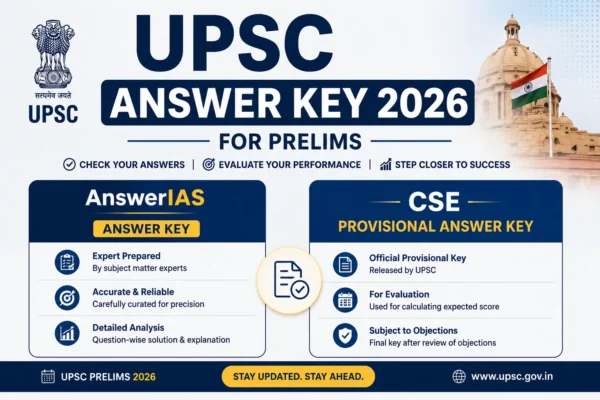
The UPSC Prelims 2026 CSAT provisional answer key will be added to this page in the hours and days that follow exam day, once the review team has cross-checked every answer across multiple reliable sources. By definition, a provisional answer key is released after exam day as a working reference for self-evaluation, and it is distinct from the official answer key that the Commission publishes much later.
The provisional answer key for this year’s CSAT will cover all four series — A, B, C, and D. Each question will carry a recommended answer with a brief explanation pointing to the source. Where two independent reviewers disagree, the question will be flagged as disputed. CSAT cycles typically produce two to four contested items, mostly in the reasoning section, and those rare items occasionally decide qualification at the borderline.
When the official UPSC answer key for the CSAT paper arrives is a separate matter. The Commission releases its official answer keys only after the entire Civil Services Examination cycle, including Mains and the Personality Test, has concluded — meaning the official key is unlikely to appear before mid-2027. Until then, every CSAT score estimate generated from a provisional answer key is an informed approximation rather than a final figure.
Why the UPSC Prelims 2026 CSAT Cannot Be Treated as a Pure Qualifier
The official position is unambiguous: CSAT is qualifying and does not count toward the Prelims cutoff. The practical reality is more nuanced. Every year, a meaningful number of candidates with strong General Studies scores fail to make it to Mains because they fell short on CSAT, and a smaller but real number with comfortable CSAT margins still come up short because they assumed the 33 percent mark would arrive on its own.
The UPSC Prelims 2026 CSAT, going by the broader pattern of recent cycles, almost certainly continued to test comprehension as the dominant pillar. The Commission has been moving away from straightforward arithmetic and toward dense, often counterintuitive passages where the right answer hinges on careful reading rather than computation. A candidate who underestimates this drift can find a once-easy paper suddenly harder than expected, even when the math itself looks manageable.
A second factor is time pressure. Eighty questions in two hours leaves an average of ninety seconds per question, and CSAT comprehension passages are not built for ninety-second reading. Candidates who walked into the UPSC Prelims 2026 CSAT without having practised at speed under realistic conditions tend to discover this gap only at the half-hour mark, when the panic-attempt phase begins. The expert analysis on this page will return to this theme.
A third factor, often overlooked, is the combined-score panic that sets in once the morning paper’s perceived score collides with an uncertain afternoon attempt. Candidates who felt confident in the GS paper often relax in the afternoon and pay for it; candidates who felt poor about the morning sometimes overcompensate in the afternoon and abandon their pacing. Neither response serves the candidate well. The afternoon paper is a self-contained exercise, and the GS attempt — however it felt — is sealed in an OMR envelope and beyond review. The discipline of treating CSAT as an independent two-hour problem, regardless of how the morning went, is one of the quieter skills the Commission rewards on aptitude day.
What the UPSC Prelims 2026 CSAT Teaches Aspirants Targeting 2027
For aspirants targeting the 2027 attempt, the UPSC Prelims 2026 CSAT is the most current and most reliable indicator of what the Commission expects on aptitude day. Older CSAT papers remain useful for sustained practice, but the 2026 paper reflects the most recent editorial decisions and provides a calibration point that older papers no longer can.
Three exercises are particularly worthwhile. The first is to attempt the paper under strict timed conditions before reading any analysis, so the candidate’s own attempt range is genuine. The second is to categorise each question as solvable through reading skill alone, through standard mental arithmetic, through formal reasoning techniques, or through a combination — this classification reveals exactly which sub-skill needs reinforcement. The third is to time each section separately and identify where time is bleeding out, because the difference between a qualifier and a borderline failure on CSAT is almost always pacing rather than raw aptitude.
A final word for 2027 aspirants. The UPSC Prelims 2026 CSAT should not become the only paper a candidate studies for the year. The right balance, for most candidates, is to spend roughly fifteen percent of total preparation time on CSAT practice — enough to clear the qualifying mark with margin, not enough to crowd out the General Studies work that determines the actual rank.
Frequently Asked Questions on UPSC Prelims 2026 CSAT
When was the UPSC Prelims 2026 CSAT conducted? The UPSC Prelims 2026 CSAT was held in the afternoon shift on Sunday, 24 May 2026, after the General Studies Paper 1 in the morning shift.
Where can I download the UPSC Prelims 2026 CSAT paper from upsc.gov.in? The official PDF will be uploaded on upsc.gov.in under the Previous Question Papers section, listed as Civil Services (Preliminary) Examination 2026, General Studies Paper 2.
What is the qualifying mark for the UPSC Prelims 2026 CSAT? Candidates must score at least 33 percent, equivalent to 66.66 marks out of 200, in the UPSC Prelims 2026 CSAT to qualify for the Mains stage.
When will the provisional answer key for the UPSC Prelims 2026 CSAT be released? The provisional answer key is prepared after exam day and added to this page in stages. The official answer key from the Commission is published only after the entire Civil Services Examination cycle concludes.
How should 2027 aspirants use the UPSC Prelims 2026 CSAT? Aspirants should attempt the paper under strict timed conditions, classify each question by sub-skill, and study where their time was spent inefficiently. The 2026 paper is the most current calibration tool available for the 2027 cycle.
A final word for everyone who walked out of the afternoon shift today. The OMR sheet is sealed, the day is over, and the worst kind of post-exam analysis is the one that begins before the brain has rested. Step away for a few hours, and return when the noise has settled. The complete expert analysis of the UPSC Prelims 2026 CSAT will be here when you do.
UPSC Mains 2026 Readiness Score and Report card : Register Here
Read Mains Relevant Current Affairs Here : https://answerias.in/current-affairs/
Last updated: 24 May 2026, 8:30 PM IST. This article will be revised as the official PDF, the provisional answer key, and detailed expert analysis become available.


2 Comments